
Automotive road freight is unusually sensitive to time because the cargo is often part of an active production system rather than simply inventory moving between two warehouses. In 2026, there are 260 automobile assembly, powertrain and battery plants in the EU and the United Kingdom. Of these, 76 produce batteries and 127 assemble battery-electric vehicles. At the same time, European automotive suppliers account for about 75% of a vehicle’s value and sustain around 1.7 million direct jobs in the EU.
That scale explains why the relevant question is not always how much the shipment costs, but what happens if it arrives too late. A Siemens study estimated the cost of unplanned downtime in automotive manufacturing at about $2.3 million per hour. This does not mean that one delayed pallet automatically creates a multimillion-dollar loss, but it shows why a dedicated vehicle costing several thousand euros can sometimes be economically preferable to a much cheaper service with an uncertain delivery window.
For transport planning, automotive parts can usefully be separated into three flows. Production parts feed manufacturing plants and are often linked to tightly controlled delivery schedules. Aftermarket or service parts replenish distribution centres, dealers and repair networks and can usually tolerate more inventory buffering. Emergency freight is different again: the shipment is triggered because a component shortage creates an immediate production risk.
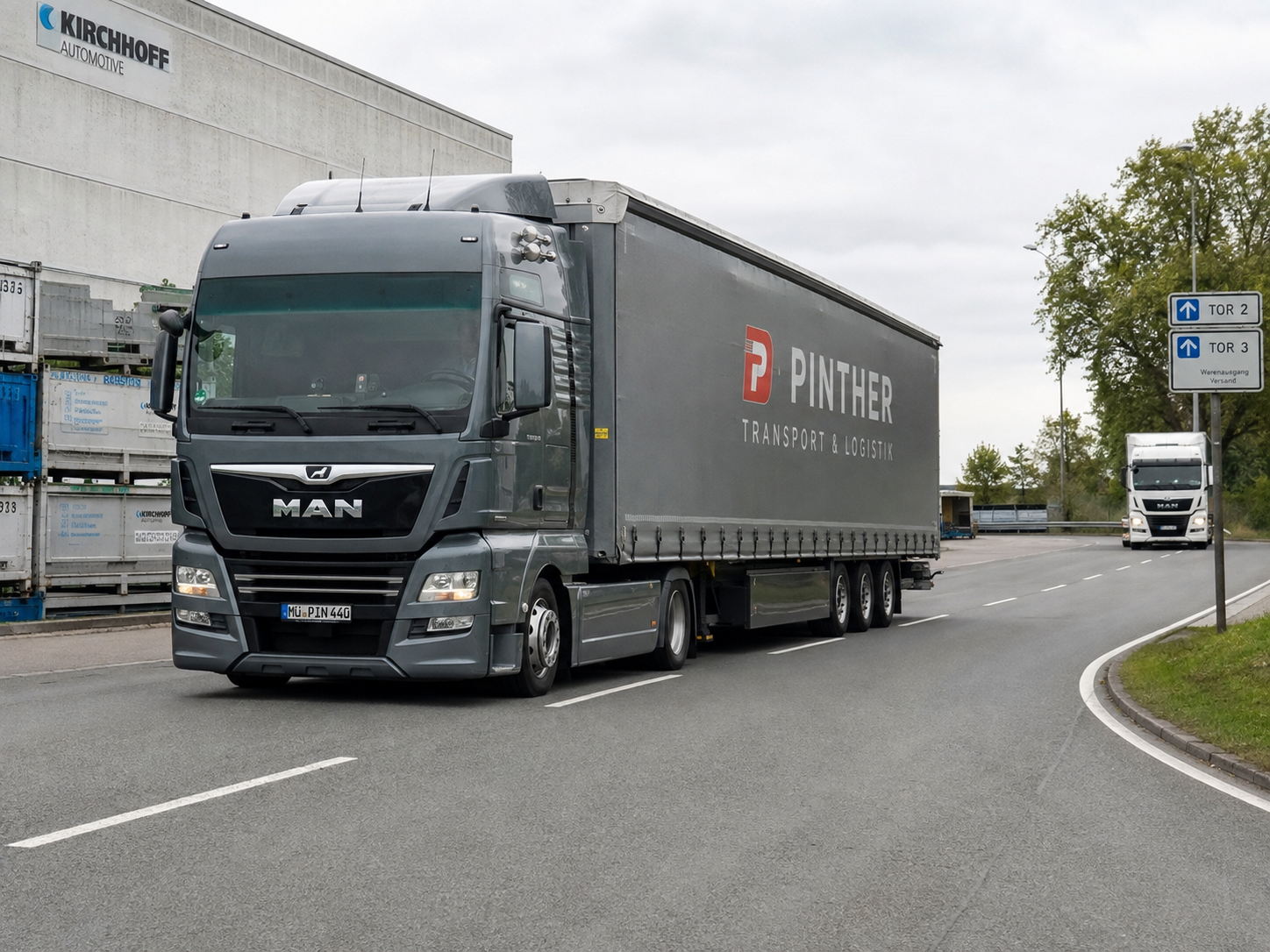
Choose the transport mode from the cargo profile, not simply from the pallet count
Ten pallets of automotive parts can represent completely different transport requirements. A dense shipment of metal parts may reach the vehicle’s weight limit while using relatively little floor space, whereas plastic trim may fill the trailer before weight becomes relevant. European road freight therefore commonly uses loading metres as well as pallet count and weight when determining the capacity consumed by a shipment. A standard EUR pallet occupies approximately 0.4 loading metres when it cannot be stacked.
Five typical cargo profiles illustrate the difference:
- Small, high-value components such as ECUs, sensors and electronic modules occupy little space but may justify direct transport when production urgency or theft exposure is high.
- Heavy components such as engines, transmissions, brake components and metal castings are frequently limited by gross cargo weight rather than pallet positions.
- Bulky light parts such as bumpers, interior trim and plastic components consume loading metres and cubic capacity quickly while remaining comparatively light.
- Repetitive production parts in KLT containers or palletised units suit scheduled groupage, consolidation, milk-run or full-load concepts depending on volume and frequency.
- Batteries, safety devices, aerosols and some chemicals or service fluids require an ADR classification check before they are treated as normal general cargo. ADR 2025 is the current framework for international road transport of dangerous goods.
The first transport decision should therefore be based on dimensions, weight, stackability, value, delivery window, handling restrictions and dangerous-goods status. Pallet count comes after those questions, not before them.
Groupage and LTL: the cheapest freight price can create a more expensive automotive delivery
European groupage typically consolidates several consignments into the same transport network. A shipment may follow a sequence such as pickup → regional terminal or cross-dock → linehaul → destination terminal → final delivery. Research on automotive inbound logistics confirms that LTL networks commonly consolidate freight from several suppliers through hubs, while automotive digital delivery standards explicitly support DESADV or ASN data for deliveries involving cross-dock activity.
For one to five pallets with normal transit requirements and sufficient safety stock, groupage is a common market solution. Several European groupage services explicitly use this range, although it is a commercial convention rather than a universal threshold.
Consider a supplier near Stuttgart sending four pallets of serial components every week to Brno. If the receiving operation has sufficient inventory and a multi-day delivery window, paying for an entire dedicated vehicle would usually be difficult to justify. Consolidation allows the shipper to pay for only part of the available trailer capacity.
The trade-off is operational complexity. Each terminal transfer creates another handling and identification point, while departure schedules and consolidation processes reduce the shipper’s control over the exact vehicle movement. For an aftermarket warehouse that holds inventory, that can be entirely acceptable. For a production delivery tied to a narrow unloading slot, the same transport architecture may introduce more timing risk than the freight saving justifies. Research into European automotive inbound networks consequently treats groupage, direct point-to-point transport and milk runs as different concepts to be selected according to the characteristics of the flow rather than as interchangeable services.
Between groupage and FTL
The most useful transport solution is often somewhere between a few groupage pallets and a full truck.
A milk run uses a scheduled vehicle to collect material from several suppliers before delivering the consolidated load to a production plant or consolidation point. Automotive transport research describes point-to-point transport, area forwarding and regular milk runs as established alternatives within inbound network design. Milk runs are particularly relevant where several suppliers can be grouped geographically and collections occur with predictable frequency.
Imagine a vehicle collecting components from four suppliers in Czechia, Slovakia and Hungary on predefined days before moving the combined load to a receiving facility. Instead of each supplier arranging a small independent shipment, capacity is planned across the entire route. The important variables become collection frequency, geographical clustering, shipment sizes and inventory requirements.
Consolidation centres extend the same principle. Suppliers send smaller consignments into a regional point where they are combined into more efficiently utilised outbound loads. Research on automotive inbound logistics explicitly models consolidation, LTL, FTL and milk-run combinations because no single transport concept is optimal across all supplier flows.
The practical progression is therefore not simply Groupage or FTL. Small irregular volumes can remain in groupage, regular medium volumes can justify part-load or milk-run structures, and large stable flows can migrate to direct FTL.
Full Truck Load: when a dedicated trailer starts to make economic sense
A standard European semi-trailer provides a useful planning baseline: approximately 13.6 metres of loading length, up to 33 standard EUR pallet positions in one layer and roughly 24 tonnes of payload, although the exact payload varies with tractor, trailer and equipment weight.
This is why 33 pallets and a full truck are not synonymous. Thirty-three pallets of lightweight plastic automotive components may exhaust the floor or volume capacity while remaining well below the weight limit. A much smaller number of densely loaded metal components can approach the weight limit first.
FTL becomes particularly attractive when a flow combines substantial volume with a strict delivery requirement. Typical cases include regular plant-to-plant movements, large Tier-1 production flows, cargo that should avoid terminal handling, deliveries with fixed unloading slots and sensitive components where additional cross-docking is undesirable.
Reusable packaging creates another automotive-specific consideration. VDA’s KLT system is designed as a poolable reusable system, and the current VDA 4500 recommendation explicitly addresses empty-container logistics and identification of reusable packaging assets. Transport optimisation can therefore involve both directions: loaded KLT units move toward production while empties are returned through the reverse flow.
Express automotive freight: when transport price stops being the main KPI
Time-critical road freight ranges from a dedicated light commercial vehicle to 7.5-tonne or 12-tonne trucks, full-size dedicated trucks and multi-driver or relay concepts. Where road transit alone cannot meet the production deadline, urgent road transport can also feed an airfreight movement.
The business logic is straightforward. Suppose a supplier discovers at 14:00 that a plant will run short of a particular electronic component the following morning. The shipment consists of only two pallets. Groupage may cost much less, but the saving is irrelevant if the service cannot meet the required delivery time. A dedicated vehicle removes consolidation waiting and sends the cargo directly toward the production site.
An important regulatory change has altered this market since 1 July 2026. EU-registered light commercial vehicles with a maximum permissible mass above 2.5 tonnes and up to 3.5 tonnes used for international road transport must now use second-generation smart tachographs and fall within EU driving and rest-time rules. The standard daily driving limit is nine hours, extendable to ten hours no more than twice in a week.
That matters for automotive express planning. Long international van movements can no longer be scheduled on the assumption that one driver can simply continue driving until the destination is reached. Vehicle selection, driver planning, relay arrangements and realistic ETA calculations now matter even more.
Groupage vs FTL vs Express: a decision model that can actually be used
There is no universal pallet threshold at which one mode becomes automatically correct. However, the following model is useful for the first transport decision:
- One to five pallets, available safety stock and a flexible delivery window: compare groupage first.
- Small recurring shipments from several suppliers in the same region: compare groupage with a scheduled milk run.
- Medium-sized loads with a precise receiving slot: compare part load with a direct vehicle.
- High regular volumes approaching trailer capacity: compare FTL and contracted direct flows.
- High-value or handling-sensitive cargo that should avoid cross-docking: consider direct transport even before the trailer is full.
- One to four pallets with an immediate production-shortage risk: dedicated express may be economically justified.
- Same-day or next-day international requirement beyond realistic road transit: investigate a road-air solution.
- Routine aftermarket replenishment with adequate stock: groupage normally deserves priority in the cost comparison.
- ADR components: choose only after classification, packaging and transport requirements have been established.
These are planning guidelines, not rigid industry rules. A better decision metric is:
Total logistics cost = transport price, handling cost, inventory cost, damage exposure, and expected business impact of delay.
The last element is the reason automotive freight sometimes appears irrational when judged only from the transport invoice. A nearly empty dedicated truck can still be the lower-cost decision when the alternative creates a credible production disruption.
Automotive packaging: KLT, returnable assets and the barcode problem
Packaging is part of the production process in automotive logistics, not an afterthought.
VDA 4500 Version 3.1, dated December 2025, defines a standardised KLT small-load-carrier system designed for automotive manufacturing and supply chains. The system is modular around 1200 × 800 mm Euro and 1200 × 1000 mm ISO bases, supports pooling and automated handling, and is intended to reduce disposable packaging while improving compatibility between users. Separate VDA recommendations cover electrostatically dissipative KLT systems intended particularly for electrical and electronic components.
Identification is equally important. The Odette Global Transport Label Profile Version 2.3, published in May 2025, supports an ISO licence plate together with technologies including Code 128, Data Matrix, QR and PDF417. Odette also describes DESADV, or ASN, as a core automotive message that allows the receiving operation to know which production parts are on the way and prepare the goods-receiving process. Its current joint DESADV guideline was published in February 2026.
That creates an automotive logistics problem that does not exist in many ordinary pallet movements: the physical cargo can arrive on time and still fail the receiving process. If the package identifier, part number or quantity on the transport label is inconsistent with the electronic despatch information expected by the receiving system, the shipment can require manual investigation instead of flowing automatically toward the correct warehouse location or assembly-line station. Odette explicitly identifies labelling and digital despatch information as mechanisms for successful routing and automated receiving within the automotive supply chain.
Not every automotive component is general cargo: the ADR traps
Automotive freight increasingly contains products that require dangerous-goods assessment. ADR 2025 has applied since 1 January 2025 and governs classification, packaging, consignment procedures, loading, handling, vehicle requirements and other aspects of international dangerous-goods transport by road.
EV batteries deserve particular attention. ADR Special Provision 376 distinguishes damaged or defective lithium and sodium-ion batteries from normal batteries. Those considered capable of rapidly disassembling, dangerously reacting, producing flame or dangerous heat, or releasing dangerous gases under normal carriage conditions must use the more stringent P911 or LP906 packing instructions. A damaged traction battery should therefore never be booked automatically as an ordinary used battery simply because both products originated in a vehicle.
Airbag modules and seat-belt pretensioners can also fall under dangerous-goods provisions. UN 3268 covers qualifying electrically initiated safety devices in Class 9, with specific conditions and exemptions depending on their configuration and installation status.
The framework is continuing to evolve. UNECE has published proposed ADR 2027 amendments covering lithium-ion, sodium-ion and hybrid battery technologies. As of August 2026, contracting parties have until 1 October 2026 to object; absent objections under the agreement procedure, the amendments are intended to take effect on 1 January 2027.
Europe’s most important automotive road-freight corridors follow the factories
The geography of automotive freight is shaped by manufacturing clusters rather than national borders. The Germany–Czechia–Slovakia–Poland–Hungary region generates particularly dense supplier and production flows, while Germany–Benelux, Spain–France–Germany, Central Europe–Romania and broader CEE–Western Europe movements link component manufacturing, vehicle assembly and distribution.
The scale of Central and Eastern Europe explains why these corridors support so many regular groupage, part-load, milk-run and FTL flows. The region accounts for roughly one third of EU vehicle production and around two million jobs across the automotive value chain.
In 2024 alone, Czechia produced about 1.447 million passenger cars, Slovakia about 994,000, Hungary about 436,000 and Romania about 473,000. Germany remained considerably larger at approximately 3.94 million passenger cars. These manufacturing concentrations create recurring movements of components and subassemblies between Western European engineering and production centres and CEE supplier clusters.
What changes when the shipment leaves the EU customs territory
A shipment from Germany to Czechia is fundamentally different from a shipment leaving the EU customs territory for the United Kingdom, Switzerland, Türkiye or another non-EU destination.
EU export procedures require customs formalities for Union goods leaving the customs territory, while an EORI number is mandatory for customs operations such as import, export and transit. Correct tariff classification is also important because the commodity code affects duties as well as measures such as licences, restrictions and origin treatment.
Common transit can simplify movements between the EU and several neighbouring markets. The current system includes the United Kingdom, Switzerland and the other EFTA states, Türkiye, North Macedonia, Serbia, Ukraine, Georgia, Moldova and Montenegro. It allows duties, taxes and certain commercial-policy measures to remain suspended while the goods move to the customs office where clearance will take place.
This becomes especially important with express automotive freight. Saving several hours through a dedicated vehicle achieves little if the shipment reaches the border before the customs data are ready. Commodity code, value, origin, export instructions and the required declarations should therefore be resolved before vehicle dispatch whenever possible. Customs preparation is part of the transit-time calculation, not an administrative task to begin when the driver reaches the border.