
Exhibition freight has a fixed operational deadline: the stand must be complete before the venue opens. A shipment that reaches the destination city on time can still miss the event if customs clearance, venue access, unloading or internal handling has not been booked. The return movement must therefore be planned at the same time as the outbound journey.
The cargo may include reusable stand structures, demonstration machines, audiovisual equipment, tools, commercial samples and branded display materials. The correct customs procedure depends on where the goods start, whether they retain Union status and whether they cross the EU customs border. Goods circulating entirely within the EU follow a different process from equipment temporarily entering the EU from a third country or leaving it for a fair abroad.
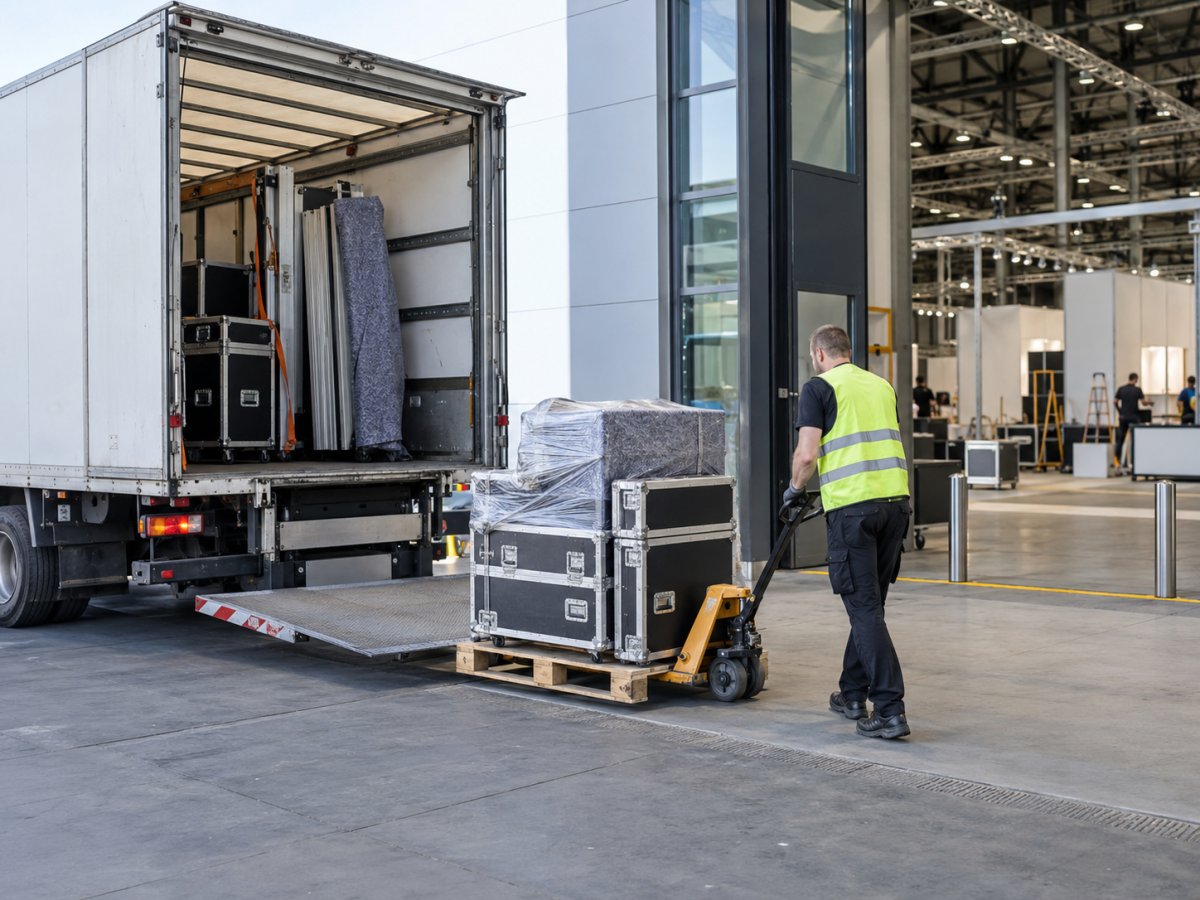
Plan backwards from the exhibition opening
The controlling time is normally the organiser’s final move-in slot, not the public opening. Working backwards from that slot reveals how much time is available for internal delivery, customs or terminal handling, line-haul transport, collection and document preparation. Road freight offers direct access to many European venues, while air freight may protect a short deadline for compact high-value equipment. Sea freight requires earlier cut-offs and more terminal coordination.
- confirm the stand number, hall, unloading gate and organiser’s move-in window;
- check whether the venue requires an official handling agent, vehicle registration or an advance delivery notice;
- reserve time for customs presentation when the journey crosses the EU customs border;
- allow a realistic buffer for border controls, terminal release, traffic restrictions and compulsory driver rest;
- book the collection after dismantling before the outbound shipment departs.
A truck arriving outside its slot may be directed to a marshalling yard or refused access. The plan should also identify who can sign documents and resolve discrepancies outside normal office hours, because many exhibition build-up and dismantling periods run during evenings or weekends.
Costs across the complete exhibition cycle
A useful quotation covers more than the international line-haul. It should identify outbound and return transport, customs representation and any guarantee, ATA Carnet issuance, airport or terminal handling, delivery at a fixed time, waiting, forklift or crane work, movement from the unloading area to the stand, storage of empty cases and collection after dismantling.
Extra charges often arise when dimensions or weights differ from the booking, the driver misses a venue slot, customs documents are incomplete, the stand is not ready for collection or the return cargo no longer matches the outbound inventory. A split quotation can be economical only if every handover and excluded service is clear. To check the transport, customs and venue-handling requirements as one operation, send the event itinerary and cargo details before booking.
Temporary admission and movement within Europe
Union goods moving directly between EU Member States are not temporarily imported merely because they are used at a trade fair. They can circulate within the EU customs territory, although commercial, transport, VAT, safety and product-specific documents may still be required. Customs formalities become central when Union goods leave that territory or non-Union goods enter it.
The European Commission describes temporary admission as a special procedure under which goods can enter the EU for a limited purpose with total or partial relief from import duty. Goods must normally remain identifiable and be re-exported or placed under another permitted procedure by the deadline fixed by customs. The general maximum can reach 24 months, but the authorised period for a particular consignment may be shorter.
Temporary admission is not permission to sell or consume the goods. If an exhibit is sold, given away, consumed, destroyed or left behind, its customs status must be regularised before the procedure is closed.
ATA Carnet: use, preparation and limits
An ATA Carnet combines standardised customs forms with an international guarantee for temporary movements. According to the International Chamber of Commerce, it can permit duty- and tax-free temporary admission for up to one year in participating countries and customs territories. It is commonly used for professional equipment, commercial samples and goods for exhibitions and fairs.
The application must reflect the actual itinerary and cargo. The general list should describe each item precisely enough for customs to identify it on export, import, re-export and re-import. Serial numbers are particularly important for machines, electronics, cameras and other individually identifiable equipment.
- holder, authorised representative and issuing association;
- countries and customs territories on the planned itinerary;
- item description, quantity, weight, value, country of origin and serial number where available;
- sufficient voucher sets for every planned export, import, transit, re-export and re-import operation;
- instructions for the driver or representative about the customs office and required endorsement at each border.
Consumables, food, giveaways and material intended to remain abroad are generally unsuitable for the carnet because they cannot be presented for re-export in the same identifiable form. Their permanent import requirements should be handled separately instead of being hidden within the temporary inventory.
Paper and digital carnets during the 2026–2027 transition
The format can no longer be assumed from previous journeys. The ICC eATA roadmap states that 30 countries had communicated readiness to accept digital carnets from 1 June 2026, including the 27 EU Member States, Norway, Switzerland and the United Kingdom. Customs administrations are nevertheless moving at different speeds during the transition.
Depending on the countries in the itinerary, an issuing chamber may provide a paper carnet, a digital carnet or both. Mixed itineraries can require paper processing in one country and digital transactions in another. Before departure, the holder should confirm the required format with the issuing association and verify that the representative carrying the goods has the paper document, digital credentials and authority needed for every checkpoint.
Documents and customs operations
The carnet does not replace the transport and commercial file. The parties should reconcile the general list with the physical packages, the transport document and the value records before loading. A different package count, missing serial number or substituted exhibit can stop the process even when the truck arrives on schedule.
- ATA Carnet or the alternative temporary-admission and re-export declarations;
- CMR consignment note, air waybill or bill of lading for the relevant transport mode;
- pro forma or commercial invoice and a detailed packing list;
- evidence of ownership and value, plus an authorisation for the customs representative;
- permits or certificates for controlled products, dangerous goods or specialised equipment;
- cargo insurance details and contact information for the exhibitor, venue and destination agent.
Every customs operation must be completed in sequence. The fact that goods were admitted temporarily does not prove that they were later re-exported. Export and import endorsements, transit closure, re-export and re-import records should be checked while correction is still possible.
Packing and delivery to the stand
Reusable flight cases, framed crates and pallet bases are usually more suitable than one-way packaging because the same equipment must survive the return journey. Each unit should carry the event name, hall, stand number, consignee, package number and handling marks. Heavy or irregular equipment needs marked lifting points and a documented centre of gravity. Photographs taken before collection establish the original condition and packing method.
Delivery to the exhibition complex is not necessarily delivery to the stand. Venue rules can require transfer to an authorised forklift, controlled movement through service corridors or temporary storage of empty cases. The booking should state who performs unloading, internal movement, unpacking, removal of packaging and the reverse operations after the event.
Return transport and discharge of the procedure
Immediately after the event, the exhibitor and handling team should compare every returning item with the outbound inventory. Missing, damaged, consumed or sold goods must be identified before the truck leaves. The return package count, serial numbers and customs list should then be reconciled with the transport document.
Three outcomes require different instructions: return to the country of origin, transfer to another fair, or permanent disposal or sale at destination. A transfer to a second exhibition may require additional vouchers, a new temporary-admission movement or different transit formalities. A permanent sale normally requires import regularisation and payment of applicable charges rather than a routine re-export entry.
Once all planned journeys and customs transactions are complete, the carnet should be returned to the issuing association for discharge according to its procedure. The holder should retain copies of the endorsed or digital transaction records because a missing exit or re-import record can trigger a customs claim.
Operational risks and contingency measures
- an inventory mismatch is controlled by a package-by-package and serial-number check before loading;
- a missed customs endorsement is addressed immediately at the border, not after the goods have travelled onward;
- a venue delay is limited by a confirmed slot, named on-site contact and booked handling equipment;
- a late return collection is managed through written dismantling times and access arrangements;
- damage or shortage is documented before repacking, with photographs, reservations and an inspection when required.
Carrier liability and cargo insurance are not interchangeable. The insurance decision should consider the full replacement value, fragile or unique exhibits, storage during the event, internal venue handling and both international journeys.
Coordination through an IFA member
A workable exhibition plan connects the origin forwarder, customs representatives, destination partner, carrier, venue handler and exhibitor through one timeline. The request should include the event dates, move-in and move-out slots, countries and border points, complete inventory, dimensions and weights, values, packaging, handling requirements and the intended destination of every item after the fair.
Members in the relevant countries can coordinate the transport and local handovers while the precise carnet holder, customs representative and venue services are confirmed for the shipment. To build the outbound and return plan around a specific exhibition deadline, request a route and document assessment.