
Transporting textile machinery across Europe is not the same as moving standard industrial cargo. These machines are often expensive, heavy, sensitive and essential for production. A delayed or damaged weaving loom, knitting machine, dyeing unit, printing machine or finishing line can affect an entire production schedule, not just one delivery.
The main goal is not only to move the machine from one country to another. It must arrive on time, in proper condition and ready for unloading, installation and commissioning. This requires technical preparation before transport, suitable packaging, correct trailer selection, secure loading, reliable documentation and, when necessary, abnormal transport permits.
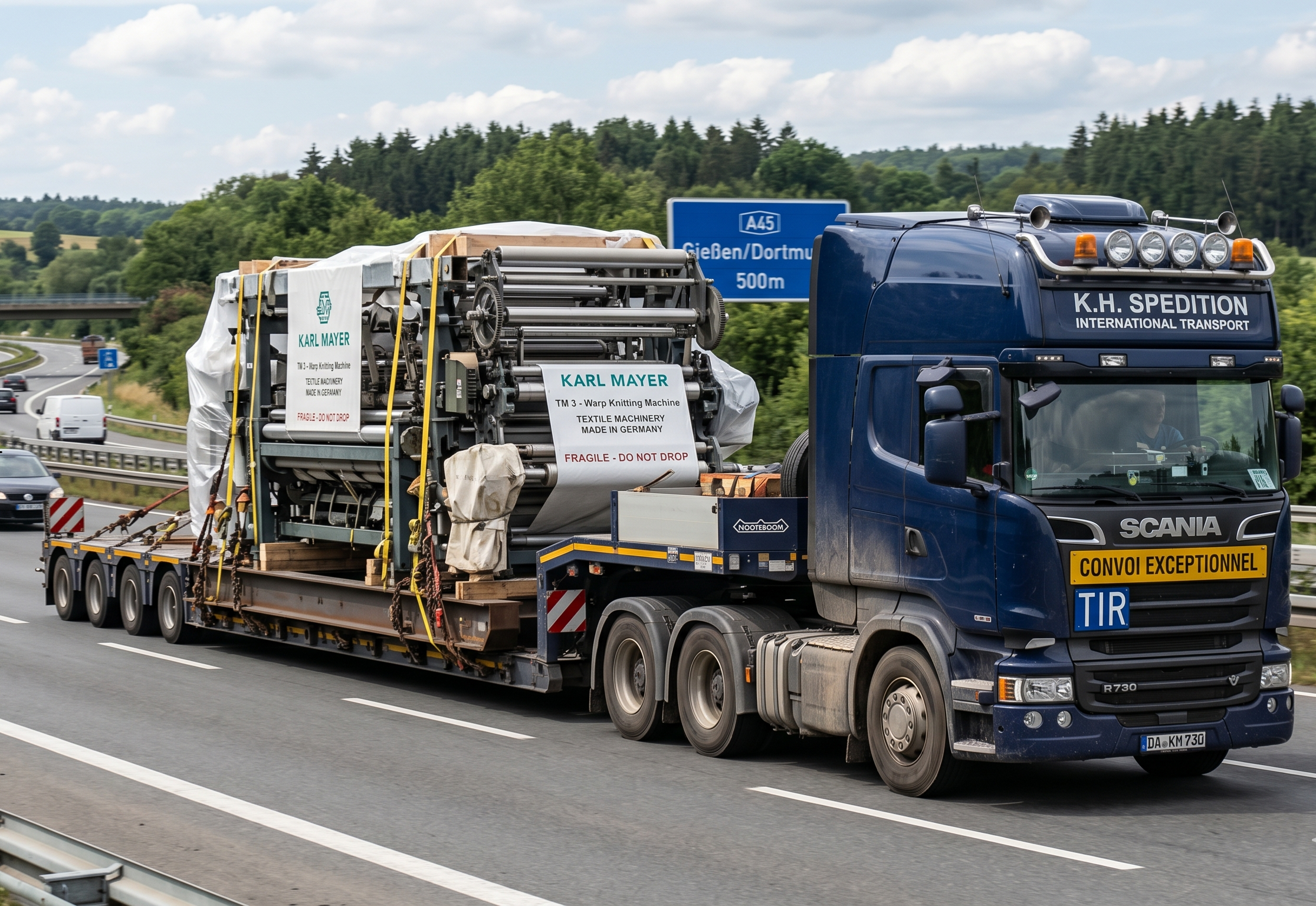
Common textile machines transported in Europe
Textile machinery includes many types of production equipment, each with different transport requirements. Some machines are compact but very heavy. Others are long, high, sensitive to vibration or difficult to lift safely.
Common examples include:
- Weaving looms and auxiliary weaving equipment
- Flat knitting machines, circular knitting machines and hosiery machines
- Cutting machines, spreading machines and garment production equipment
- Embroidery machines and sewing-related production units
- Dyeing, washing, drying and finishing lines
- Digital textile printing machines and textile coating equipment
- Dryers, calenders, compacting machines and pressing systems
- Winding, unwinding, rolling and fabric inspection systems
A compact dyeing unit may create a weight and lifting problem. A fabric inspection line may create a length problem. A digital textile printing machine may fit into a standard trailer but need better protection against vibration, moisture and dust. This is why the transport plan must be based on the real machine, not only on its name or catalogue category.
Main European routes for textile machinery
Many textile machinery transports in Europe connect machinery markets such as Germany, Italy, Belgium, the Netherlands and France with production destinations such as Poland, Romania, Bulgaria, Serbia and Turkey. Some shipments involve new equipment. Others involve used machines purchased from factories, auctions, modernization projects or production relocations.
A practical example is a used textile machine loaded in Italy and delivered to Bulgaria. On paper, this may look like a normal international road transport. In practice, the route depends on the loading site, machine dimensions, available forklifts or cranes, border points, delivery appointment and unloading conditions. Another example is a new finishing line from Germany to Turkey, where the main machine, control cabinets, rollers and accessories may need several vehicles and separate customs planning.
The shortest route is not always the best route. For high, wide or heavy textile machines, the safer option may be a longer road that avoids low bridges, unsuitable tunnels, roadworks, restricted urban areas or border crossings that are difficult for abnormal loads.
Information needed before a transport offer
A reliable offer starts with a technical description of the machine. For textile machinery, a simple price per kilometre is not enough, because the trailer, loading method, permits and route may all depend on details that are not visible from the machine name.
Before transport planning, the client should prepare:
- Exact transport dimensions, including packaging, pallets, skids and protruding parts
- Gross weight of each unit, not only the approximate machine weight
- Centre of gravity, especially if the machine is tall, narrow or unevenly balanced
- Photos from all sides, including the base, lifting points and fragile parts
- Machine drawings, dismantling scheme or installation layout, if available
- Confirmed lifting points and information about lifting beams or special equipment
- Packaging status, including whether the machine is crated, wrapped, fixed on skids or unpacked
- Details about dismantled parts, accessories, rollers, control cabinets and spare parts
- Information about electronics, sensors, panels, print heads, shafts, guides or needle systems
- Information about residual oils, liquids or chemicals that may need draining or special handling
- Loading and unloading conditions, including forklift capacity, crane access, ramps, door height and yard space
This information prevents wrong trailer selection, failed loading, additional waiting time and unsafe handling. For example, a machine that is 2.80 m high may exceed the usual 4.00 m loaded height if placed on a standard trailer. A machine that weighs 6 tonnes may still require a stronger forklift if the centre of gravity is far from the forks.
Packaging and machine protection
Textile machinery may look strong from the outside, but many parts inside are sensitive. Electronic panels, sensors, shafts, guides, rollers, print heads, needles and calibrated mechanisms can be damaged by vibration, moisture, dust or incorrect securing.
Good packaging should protect the machine from weather, road dirt and contact damage. Movable parts should be locked or blocked before transport. Control panels, cables, connectors and exposed components should be protected separately. If the machine is transported unpacked, it needs careful wrapping and clear marking of fragile zones, lifting points and areas that must not be used for securing.
A common risk is that the machine is fixed to the trailer, but its internal moving parts are not fixed. During a long international journey, braking, vibration and cornering can cause damage that becomes visible only when the machine is installed and tested. This is especially important for digital textile printing machines, knitting equipment and machines with precision guides or alignment-sensitive parts.
Choosing the right truck and trailer
The correct vehicle depends on the machine dimensions, weight, loading method and protection needs. If the machine fits within standard road dimensions, transport is usually faster, simpler and more economical. In European road planning, the usual standard limits are around 2.55 m width, 4.00 m overall height, 16.50 m length for articulated vehicles, 18.75 m for road trains and 40 tonnes gross weight for many international combinations.
A tarpaulin trailer is often suitable when the machine fits standard dimensions and needs weather protection. It also allows side loading by forklift. A flatbed or open platform may be used when the machine must be loaded from above by crane, but then weather protection becomes more important. A low-bed trailer is useful when height is the main issue, because the lower loading deck can reduce total loaded height. Extendable trailers may be needed for long frames, drying sections, inspection lines or machine parts that cannot be shortened.
Before planning abnormal transport, it is worth checking whether the machine can be safely dismantled. Removing an upper frame, beam, cabinet or accessory can sometimes reduce height or width enough to avoid permits and escorts. However, dismantling must be approved by the technical team, because incorrect disassembly can create problems during installation.
Loading, securing and weight distribution
The machine must be positioned correctly on the trailer, not just loaded. Poor positioning can overload axles, create instability or damage the machine frame. Load securing must prevent sliding, tipping, twisting and movement during braking or cornering.
European load securing calculations often use forces such as 0.8 g forward and 0.5 g sideways and rearward. This shows why a machine that looks stable in the factory may still be unsafe on the road. A heavy machine with a small contact area can create high point loads on the trailer floor. A tall and narrow machine may have a tipping risk even if it does not slide easily.
Securing must also protect the machine itself. Belts should not press against sensors, covers, control panels, rollers or precision parts. Chains may be suitable for strong machine frames, but only at approved contact points. Anti-slip mats, timber supports, stoppers, cradles and edge protectors are often as important as the straps or chains. The securing force should pass through strong structural parts, not through guards or delicate components.
When abnormal transport is required
Abnormal transport is needed when the vehicle and load exceed standard legal limits for width, height, length, total weight or axle load. In Europe, permits are usually handled by each country on the route, and conditions may differ from one border to the next.
For example, a textile machine travelling from Germany through Austria and Hungary to Bulgaria may need separate route checks and permits. In Germany, heavy vehicles over 7.5 tonnes are generally restricted on Sundays and public holidays from 00:00 to 22:00 unless an exemption applies. In Austria, special transport on motorways and expressways may require registration when the load is wider than 3.50 m or higher than 4.30 m. In Hungary, route permits are required when limits such as 4.00 m height, 16.50 m semi-trailer length, 18.75 m road train length, 40 tonnes gross combination weight or 11.50 tonnes axle load are exceeded.
These figures are practical planning triggers, not a complete legal assessment. A machine that is 3.20 m wide, 4.35 m high when loaded or slightly above normal gross weight may require permits, a specific route, escort vehicles, movement only during certain hours or approval from road authorities. This must be checked before loading, not after the truck reaches the border.
Documents for textile machinery transport
Good documentation reduces delays at loading, border control, customs and unloading. The most important documents usually include:
- CMR consignment note for international road transport
- Commercial invoice with correct buyer, seller, value, currency and machine description
- Packing list with all units, dimensions, gross weights and accessories
- Serial numbers, model details and identification plates, when available
- Loading and unloading instructions, including lifting points and handling limits
- Export, import or transit documents when the route or destination is outside the EU customs area
- Documents for origin or customs status, where required
- Abnormal transport permits, route approvals and escort documents, when applicable
- Cargo insurance certificate or policy confirmation
- Photos before loading, after loading and after securing
Within the EU, goods in free circulation can usually move without import customs clearance between member states. However, transport to or from Turkey, Serbia, Switzerland or the United Kingdom requires customs preparation. Delays often come not from the road itself, but from missing invoice data, unclear machine descriptions, wrong gross weight, missing serial numbers or incomplete transit documents.
For used machinery, the documents should clearly identify the machine and all dismantled parts. If the main machine, control cabinet, rollers and spare parts travel in different trucks, the packing lists must make this clear.
Insurance and carrier liability
Carrier liability is not the same as cargo insurance. Carrier liability is the legal responsibility of the carrier under transport rules. Cargo insurance protects the value of the goods according to the agreed insurance conditions.
For many international road transports under CMR, compensation may be limited by weight, often to 8.33 SDR per kilogram, unless a higher value or special interest in delivery is declared and accepted. This can be insufficient for textile machinery, because value is not always proportional to weight. A relatively light digital printing machine can have a much higher value than the compensation calculated by kilogram.
Damage can also be hidden. A machine may have no visible external damage, but a shock can affect calibration, electronics, print heads, alignment, rollers or sensors. For high-value machines, cargo insurance should be considered based on purchase value, replacement value or agreed commercial value.
Warehousing, transshipment and intermediate logistics
Textile machinery cannot always be delivered directly to the production hall. The site may not be ready, the floor may still be under construction, the installation team may arrive later or the machine may need to be combined with accessories from another shipment.
In such cases, warehousing can be a useful stage of the delivery. A suitable warehouse can receive the machine, check visible condition, store it in a dry and secure area, group accessories, prepare documents and organize final delivery. The warehouse must be suitable for the cargo, with adequate door height, floor capacity, forklift or crane access, humidity control and enough space for safe handling.
Transshipment may also be necessary when the long-distance truck cannot reach the final site. The machine can be moved to a smaller vehicle, low-bed trailer or crane-assisted local delivery solution for the last kilometres. For complex textile lines, intermediate logistics also helps ensure that the main machine, control cabinets, rollers, guards and spare parts arrive together and are ready for installation.