
A boat does not need to be exceptionally large to become an abnormal road load in Europe. Under EU rules, the standard maximum width for most road vehicles is 2.55 m and the standard maximum height is 4.00 m. Anything beyond those limits can require national exemptions or special permits.
This immediately puts many recreational boats outside normal road dimensions. The original Jeanneau Merry Fisher 895, for example, is 8.90 m long, 2.99 m wide and approximately 3,500 kg without engines. A Princess V50 is 16.02 m long, 4.08 m wide and has an approximate displacement of 18.2 t. The Beneteau Oceanis 46.1 measures 14.60 by 4.50 m, with a light displacement of 10,597 kg and an air draft of 20.31 m. At the larger end of the examples in this article, the Sunseeker Manhattan 55 is 17.21 m long, 4.87 m wide and has a displacement of 27 t.
These figures illustrate an important point: describing a shipment simply as a 15-metre yacht is not enough. Beam and final loaded height may influence permits, escorts and route selection more than hull length.
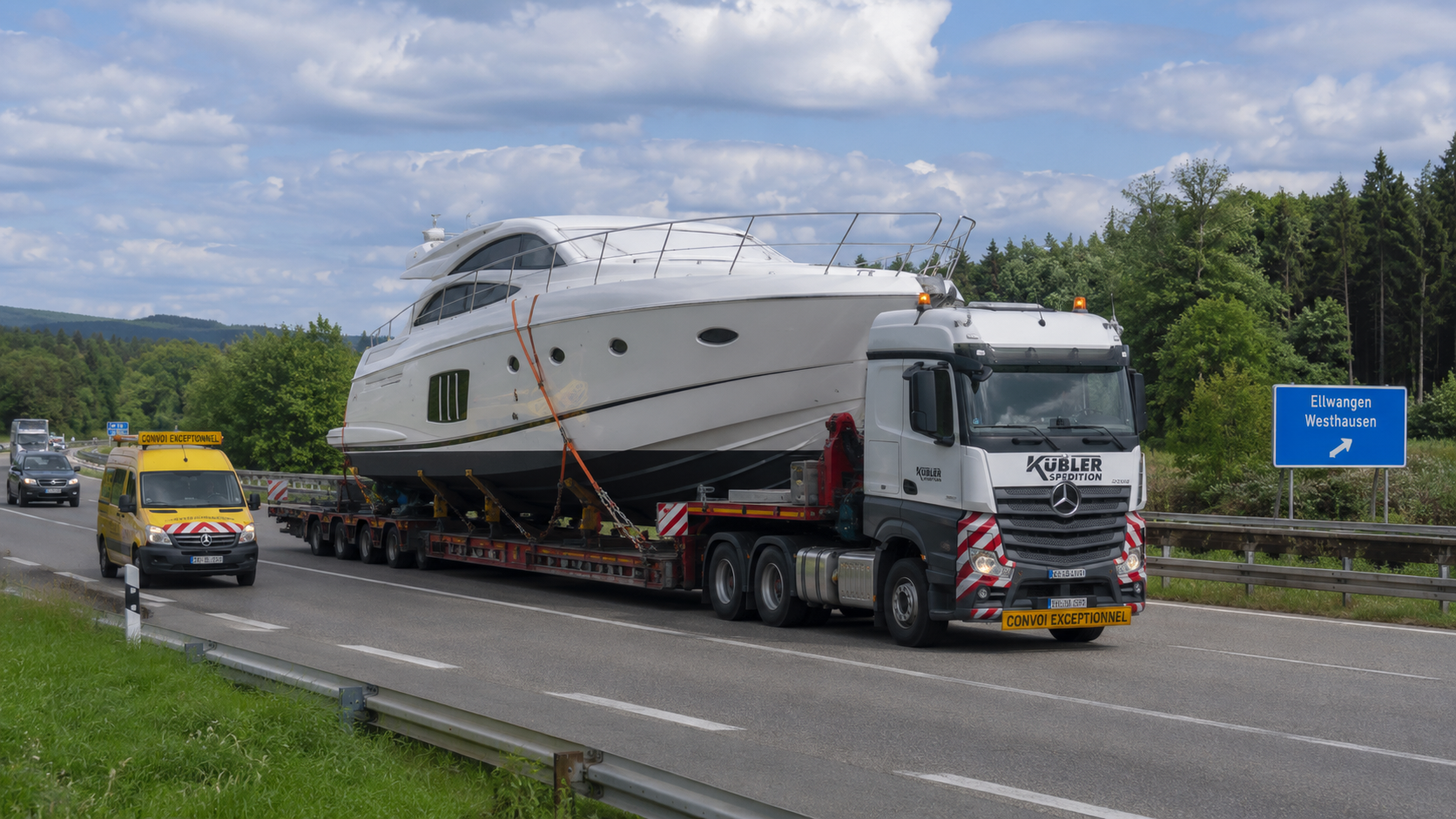
The four numbers needed before requesting a transport quote
The dimensions required for road transport are not necessarily the numbers highlighted in a yacht brochure. The transport planner needs the dimensions of the yacht in its actual road configuration.
The essential information is:
- overall length after everything that can or must be removed has been removed;
- maximum transport width, including any protruding components;
- actual transport weight, including equipment remaining aboard;
- final loaded height from the road surface to the highest point of the load.
The last figure is particularly important. In practical terms, loaded height consists of trailer deck height, cradle or support height and the vertical dimension of the yacht from the lowest supported point of the hull to the highest remaining component.
Draft and air draft are therefore not substitutes for road transport height. The Oceanis 46.1, for example, has a catalogue air draft of 20.31 m, which clearly demonstrates why a sailing yacht of this size cannot travel by road with the mast stepped.
Masts, radar arches, aerials, wind instruments, sprayhoods, biminis, navigation lights, flybridge windscreens, tenders and other exposed equipment can often be removed. Industry transport guidance also recommends reducing fuel and water, draining bilges where appropriate, disconnecting batteries and securing hatches and loose equipment.
Removing a component that reduces loaded height by only 20 or 30 cm can be economically significant. In the Netherlands, for example, an extensive route investigation becomes compulsory above 4.40 m transport height. Avoiding such a threshold can change the route-planning workload considerably.
The trailer matters almost as much as the yacht
Large boats are normally carried on low-bed or low-loader semi-trailers. Longer craft may require extendable trailers, while heavier or less manoeuvrable combinations can use hydraulic steering systems. The hull itself must be supported correctly, typically through a purpose-designed cradle or adjustable support arrangement that distributes loads without creating excessive concentrated pressure on the hull.
Deck height is critical. A trailer that carries the hull 10 cm lower may offer greater practical value than a modest reduction in cargo weight if those 10 cm allow the combination to pass beneath an obstacle or remain below a regulatory threshold.
Weight must also be considered as a complete vehicle combination. A 20 t yacht does not produce a 20 t road transport. The tractor, trailer, cradle and equipment all contribute to gross combination mass, while individual axle loads must remain acceptable.
EU cargo-securing principles require restraint capable of withstanding forces equivalent to 0.8 times cargo weight in the forward direction and 0.5 times cargo weight laterally and rearward. Load distribution must also take maximum and minimum axle loads into account.
There is no single European oversize permit
One of the most important facts for international yacht transport is that crossing the EU border does not create a single EU-wide abnormal-load permit. National and sometimes regional authorities retain their own permit categories, escort rules, movement times and route-approval procedures. The European Commission has reported that national abnormal-load permits can take from approximately one or two weeks to as long as 12 weeks, depending on the country, route and complexity.
France classifies exceptional transports according to the most restrictive characteristic of the complete convoy. Category 1 covers up to 20 m overall length, 3 m width and 48 t. Category 2 extends to 25 m, 4 m and 72 t. Exceeding any corresponding Category 2 threshold places the transport in Category 3.
This means the 2.99 m beam of the original Merry Fisher 895 is close to the French Category 1 width ceiling, although the dimensions and weight of the complete loaded vehicle still determine the final category. A Princess V50 transported at approximately its 4.08 m beam would already exceed the Category 2 width limit and therefore enter Category 3 on width alone.
Spain uses three ACC categories. For the relevant class of special transport, a generic authorisation covers a loaded combination up to 20.55 m long, 3.00 m wide, 4.50 m high and 45 t. A specific authorisation extends the dimensional envelope to 40 m long, 5 m wide and 4.70 m high, with higher permitted mass subject to the applicable rules. Anything beyond the specific limits becomes exceptional. The DGT fee for an ACC in 2026 is €132.72.
In the Netherlands, an annual exemption for an indivisible load can cover up to 27.50 m length, 3.50 m width, 4.25 m height and 100 t. Larger transports need an incidental route-specific exemption. Above 4.40 m loaded height, an extensive route investigation must accompany the application.
Germany handles oversized and heavy transport applications through VEMAGS. Official administrative fees currently range from €40 to €1,300 depending on dimensions, weight, vehicles, authorities involved and processing effort. A normal processing period of around two weeks is indicated by federal administrative information, while applications involving structural bridge calculations can require longer.
Escort vehicles
Escort requirements often change at exact dimensional thresholds rather than increasing gradually. The Netherlands provides an unusually clear example.
On motorways, a transport up to 4.00 m wide requires no escort solely because of width. From 4.01 to 4.50 m, one escort is required. From 4.51 to 5.00 m, two are required. On the secondary road network, the rules become stricter: 3.51 to 4.00 m requires one escort, while 4.01 to 4.50 m requires two. Movement time restrictions also tighten as width increases.
Applied to the examples here, a Princess V50 transported at 4.08 m may require one escort on a Dutch motorway but two on parts of the secondary network. A Manhattan 55 transported at approximately 4.87 m falls into the two-escort width band even on motorways. The legally relevant number is always the final transport width, not simply the manufacturer-published beam.
France uses several forms of private accompaniment, including pilot vehicles, rear protection vehicles and, for more demanding combinations, additional guidance. The required arrangement is determined by width, length and mass. French rules show, for example, that transports between 3 and 4 m wide in Category 2 generally require a pilot vehicle, while larger Category 3 combinations can require both front and rear protection and additional guidance.
Germany uses private escort arrangements including BF3 and BF4 vehicles, with the precise traffic-management measures defined in the permit. Official motorway guidance recognises both BF3-qualified personnel and BF4 transport escorts.
What yacht transport really costs
A simple price per kilometre can be misleading because distance is only one component of an oversized yacht movement.
A proper cost breakdown should separate:
- tractor, specialist trailer, loaded kilometres and positioning mileage;
- permit fees in every relevant jurisdiction;
- escort vehicles and any required traffic-control support;
- route survey and engineering checks;
- tolls, tunnel charges and restricted-hours operation;
- crane or travel-lift loading and unloading;
- mast removal, re-stepping and other dimensional reduction work;
- cradle or specialist support equipment;
- waiting time at marinas, borders or restricted route sections;
- additional cargo insurance where standard liability is insufficient.
Published 2026 European marketplace transaction data show international boat and yacht movements ranging roughly from €0.65 to €1.97 per kilometre in one national dataset. However, those figures include relatively small and straightforward boats and should not be applied to a 4 or 5 m wide yacht.
Published 2026 road-transport guidance for boats of more than roughly 12 m gives an indicative 1,000 km range of approximately €4,000 to €6,500 before escorts, permits and mast-related work.
Escort vehicles can become a major separate item. Published French market guidance in 2026 uses around €1.40 per kilometre as a private pilot-car reference price, but this is a commercial indication rather than an official tariff. Night work, additional vehicles, positioning and route reconnaissance can raise the total substantially.
For this reason, comparing two large-yacht quotations only by €/km can produce a false result. Permits, escorts, surveys, cranes, waiting and insurance should be visible as separate cost items.
Three yachts, three very different transport jobs
The original Merry Fisher 895 illustrates the lower end of abnormal boat transport. At 2.99 m beam, it exceeds the normal EU width of 2.55 m but remains just within the 3.00 m width thresholds used in the first French category and Spain’s generic ACC dimensional envelope. The complete truck and trailer combination must still comply with the remaining length, height and mass conditions.
The Oceanis 46.1 is a fundamentally different operation. Its 4.50 m beam and 10.6 t light displacement mean the planning sequence normally begins with haul-out and mast removal, followed by cradle preparation and measurement of the final loaded dimensions. Its 20.31 m standard air draft confirms that the rig must be treated as a separate transport element rather than left standing. At 4.50 m road width, it also reaches significant permit and escort thresholds in several European systems.
The Manhattan 55 illustrates why the shortest route may not be the lowest-cost route. At 4.87 m beam and 27 t displacement, it enters the two-escort motorway band in the Netherlands purely on width. Depending on loaded height and route, bridges, tunnels, roadworks and restricted movement windows may make a longer route operationally simpler.
Route survey
Route planning for a 4.5 m wide yacht is closer to engineering than ordinary vehicle navigation. Authorities may evaluate not only whether a road connects the origin and destination, but whether the complete vehicle can physically and structurally use it.
A proper route survey considers:
- bridge, viaduct, tunnel and overhead-cable clearances;
- available lane and carriageway width;
- toll booths and restrictive gantries;
- turning radii, roundabouts and swept path;
- temporary roadworks and lane closures;
- bridge capacity and axle-load restrictions;
- gradients and locations where trailer height can change relative to structures;
- access, turning space and trailer positioning inside the departure and destination marinas.
The Dutch requirement is particularly concrete: an extensive route investigation is mandatory for an incidental exemption when transport height exceeds 4.40 m. The application must identify bottlenecks such as bridges, roundabouts, signs and power lines and explain how each will be passed.
Austria provides an even more unusual example of route policy. For certain international special transports using the Danube corridor, inland waterway transport is in principle required when total weight exceeds 160 t, total height exceeds 4.5 m or total width exceeds 5.6 m, provided the specified border-crossing and route conditions are also met. Road permission may still be possible when inland-waterway transport is shown to be impossible or disproportionately difficult.
The practical lesson is simple: the route must be designed around the loaded yacht.
Country-specific details
Spain demonstrates why a permit described as national may still not cover an entire journey. DGT authorisations issued from 1 May 2024 onward are not valid for roads in Catalonia; movements there require the relevant Catalan authorisation. This matters directly for yacht traffic to or from Barcelona and other Catalan ports.
Spain also requires notification before movements under specific and exceptional ACC categories. Where police accompaniment or authorised self-escort is required, the request must be made at least 72 hours before departure.
In the Netherlands, a transport wider than 3.50 m must check the permitted route no more than 24 hours before departure for roadworks, events and other temporary restrictions.
German permits are route-specific and can require consultation with multiple road authorities. Bridge calculations can extend the preparation period beyond the usual two-week processing expectation.
This is why crane bookings and marina slots should ideally follow route confirmation rather than determine it.
Preparing the Yacht Before Loading
Road preparation should focus particularly on equipment that changes dimensions, weight distribution or the risk of damage.
Before the trailer arrives, the preparation should normally include:
- unstepping the mast and securing the mast, rigging and vulnerable instruments separately;
- removing radar units, antennas, sprayhoods, biminis, protruding windscreens and other exposed components;
- reducing fuel and freshwater to the agreed minimum and draining bilges as appropriate;
- disconnecting or isolating batteries;
- securing hatches, windows, lockers and doors mechanically;
- removing gas bottles and other hazardous or flammable materials where required;
- securing or removing anchors, tenders, outboards and other external equipment;
- taking dated photographs and completing a condition report immediately before handover.
These measures are consistently included in published yacht-transport preparation guidance.
There is another practical constraint at the marina. A travel lift or crane must have enough lifting capacity for the yacht, but that alone is insufficient. The specialised trailer must also be able to enter the site, align beneath the lift and leave again with the yacht at its final loaded dimensions.
Insurance
International road transport in Europe commonly falls under the CMR liability regime. Under the CMR Protocol, the carrier’s standard liability for loss is generally limited to 8.33 Special Drawing Rights per kilogram of gross weight affected.
That distinction matters enormously for yachts. Applying the weight-based limit to a 10,597 kg Oceanis 46.1 gives approximately 88,300 SDR before considering the detailed circumstances of a claim. The market value of a yacht can be substantially higher than the compensation calculated through a weight-based liability limit.
Before transport, the owner or broker should therefore establish:
- the applicable CMR liability limit;
- whether separate all-risk cargo cover is in force;
- the declared insured value of the yacht;
- whether loading and unloading by crane or travel lift are covered;
- whether mast removal, dismantling and re-rigging fall within the policy.
Separate transport insurance can therefore be especially important for lightweight, high-value sailing or performance yachts. Published specialist transport guidance also warns specifically that CMR compensation calculated by weight can be far below a yacht’s real value.