
A ferry crossing can carry the loaded truck or trailer as one transport unit, without transferring the goods into a container or unloading them at the port. The operational choice is whether the driver and tractor travel with the load or a different tractor collects the trailer after arrival.
For a workable delivery plan, the sea passage must be matched with terminal deadlines, customs requirements and onward road capacity. The following twelve European freight connections illustrate those choices across six sea areas.
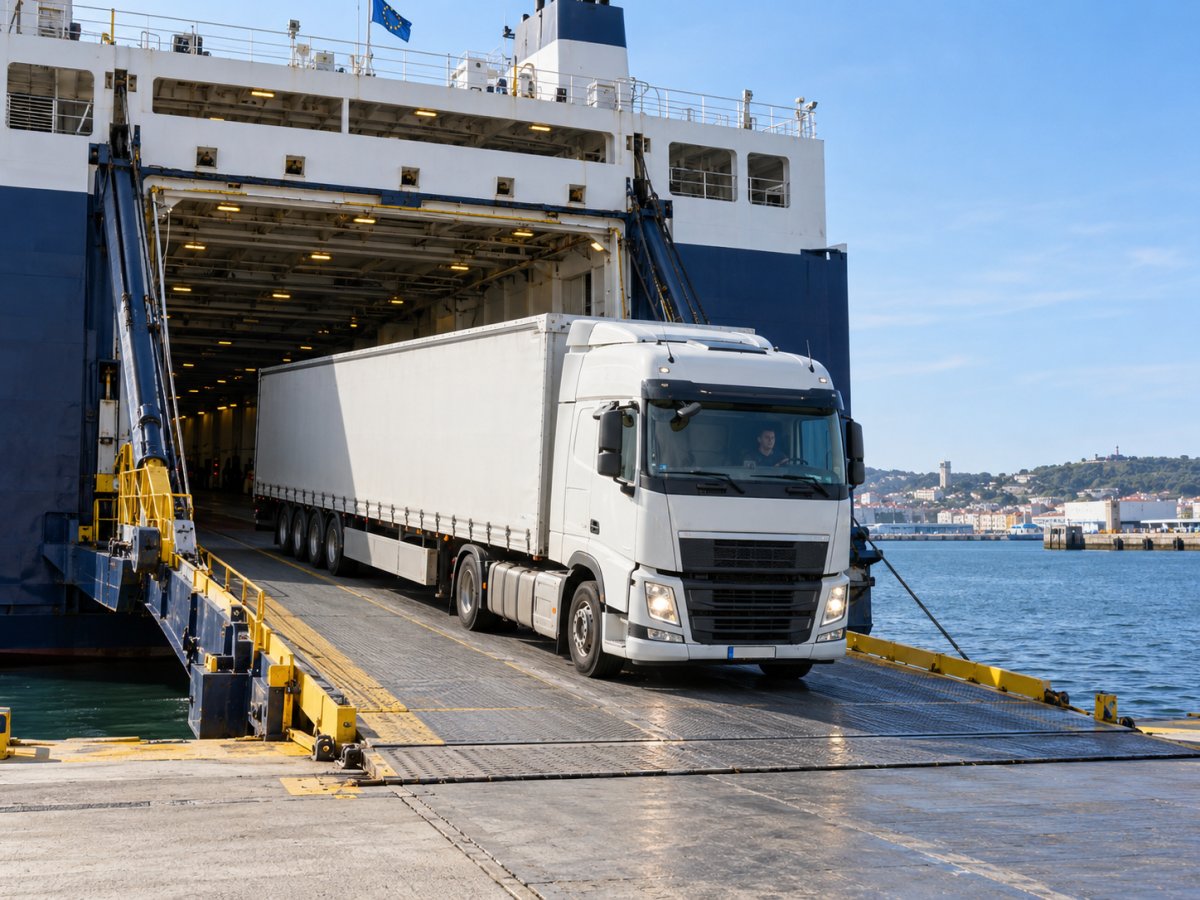
Accompanied trucks and unaccompanied trailers
Ro-Ro means roll-on/roll-off: wheeled transport units enter and leave the ship via a ramp. In an accompanied movement, the tractor, trailer and driver travel together. Driver accommodation and the ability to continue driving after arrival become part of the planning.
With an unaccompanied trailer, one tractor delivers the unit to the departure terminal and another collects it at the destination. The booking must cover terminal handling, trailer identification, release instructions and collection responsibility. A route accepting trucks does not automatically accept every trailer-only arrangement, abnormal unit or dangerous-goods class.
Booking, terminal deadlines and the delivery schedule
Booking information should identify the vehicle or trailer, actual dimensions and weight, cargo type, driver arrangements and any temperature-control or dangerous-goods requirements. The terminal cut-off is the latest time for presenting a unit ready for loading; it is not the ship’s departure time.
For example, published freight check-in instructions at Fishguard distinguish accompanied units, normally due 40 minutes before departure, from unaccompanied units, due 60 minutes before departure. Hazardous units have separate deadlines. These are route-specific examples, not a rule for all European ports.
Allow for the road approach, check-in, controls, sailing, discharge and release before promising a delivery slot. A missed departure may add more than the sailing time itself. Time aboard is not automatically qualifying driver rest: the applicable rules and actual accommodation and interruption arrangements must be checked separately.
The ferry price and the complete delivery cost
Compare quotations for the same vehicle dimensions, cargo and sailing date. Check whether the price includes the driver, cabin, terminal movements, fuel adjustment, environmental surcharges, reefer electricity and any storage after the permitted collection period. For an unaccompanied option, include tractor work at both ends rather than comparing the sea fare alone.
EU maritime emissions trading and FuelEU Maritime are distinct regulatory measures. A commercial surcharge is not a universal statutory percentage of every freight ticket; its amount and presentation depend on the service and quotation.
Request a coordinated quotation covering the ferry crossing, terminal arrangements and onward road delivery.
The English Channel
- Dover–Calais, United Kingdom–France: approximately 90 minutes at sea, linking Kent with northern France and onward routes towards Belgium and continental Europe. Accompanied trucks are a standard option; trailer-only movements require a specifically confirmed drop-off and collection service. The port’s crossing-time guidance does not include check-in or the UK–EU border procedures.
- Dover–Dunkirk, United Kingdom–France: approximately two hours at sea, with access towards northern France, Belgium and the Netherlands. Freight services provide for accompanied vehicles and booked unaccompanied trailers. Check the freight terminal at Loon-Plage, not a general address in central Dunkirk, and arrange the required customs references before arrival.
The North Sea
- Hoek van Holland–Harwich, Netherlands–United Kingdom: plan approximately seven to eight hours, with the actual duration depending on the booked day or night sailing. Accompanied and unaccompanied freight arrangements connect the Rotterdam region with Essex and onward routes towards London and eastern England. Hoek van Holland and Rotterdam Europoort are different terminals and must not be interchanged in instructions.
- Rotterdam (Vlaardingen)–Immingham, Netherlands–United Kingdom: an overnight connection with roughly eleven to eighteen hours in the published October 2026 sailing pattern, depending on the departure. Accompanied units and trailers are handled on a route linking the Benelux area with the Humber and northern and central England. Specify Vlaardingen and the correct Immingham terminal; customs release and trailer collection are additional to sailing time.
The Irish Sea
- Holyhead–Dublin, United Kingdom–Ireland: freight crossings start from approximately three hours fifteen minutes, with the booked sailing determining the actual time. Accompanied trucks and unaccompanied units connect north Wales with Dublin’s motorway network. This is a Great Britain–Ireland crossing, not a direct connection from continental Europe; a journey through Great Britain also needs appropriate transit planning.
- Fishguard–Rosslare, United Kingdom–Ireland: approximately three hours thirty minutes, connecting south Wales with south-east Ireland and onward roads towards Cork and Dublin. Both accompanied and unaccompanied freight have published terminal procedures. Different presentation deadlines apply to the two arrangements, and abnormal loads need advance clearance.
The Baltic Sea
- Travemünde–Trelleborg, Germany–Sweden: allow roughly eight to eleven hours depending on the sailing, rather than assuming every departure has the same duration. Accompanied trucks and trailers connect the Lübeck region with southern Sweden, with road and rail options on both sides. Confirm trailer handover, collection arrangements and any special-cargo acceptance for the selected departure.
- Rostock–Gedser, Germany–Denmark: approximately two hours at sea, connecting north-eastern Germany with Denmark and onward Scandinavian routes. Accompanied trucks are carried, while unaccompanied trailers are available on selected departures. The existence of a frequent passenger timetable does not mean every departure offers the same trailer-handling capacity.
The Adriatic Sea
- Ancona–Igoumenitsa, Italy–Greece: broadly around a day at sea, with the exact duration varying by service, direction and intermediate calls. The connection carries freight vehicles between central Italy and western Greece, supporting road deliveries into the Balkans. Confirm whether the specific booking permits a tractor-and-driver combination or an unaccompanied trailer, and check whether a Corfu call changes the timing.
- Bari–Patras, Italy–Greece: an overnight route of approximately seventeen hours in standard patterns, with longer journeys possible when the itinerary changes. Accompanied freight vehicles are carried; any trailer-only movement needs separate confirmation. Igoumenitsa and, on some schedules, Sami or Corfu are intermediate calls, so the time to Patras must not be confused with the earlier arrival at Igoumenitsa.
The Mediterranean Sea
- Barcelona–Civitavecchia, Spain–Italy: approximately one day at sea, connecting Catalonia with the Rome region without driving around the northern Mediterranean coast. The route carries freight vehicles; confirm accompanied or unaccompanied acceptance against the chosen freight service. Additional calls and seasonal sailing changes can alter the duration, and a passenger vehicle reservation is not a substitute for a commercial freight booking.
- Pendik–Trieste, Türkiye–Italy: plan a multi-day sea leg, broadly around three days; some published departures exceed eighty hours. Trailers and complete vehicles are carried, but the driver’s travel arrangements and onward tractor must be specified separately. The connection links the Istanbul region with northern Italy and central Europe, with external-border formalities and possible intermediate calls affecting the complete delivery plan.
These are selected freight connections, not a complete directory or a ranking by traffic. Durations are planning indications checked against published information in October 2026, not guaranteed transit times. Timetables use local port times, so time-zone differences must be allowed for when calculating elapsed time.
Documents and customs formalities
Keep the transport document, commercial invoice, packing information, booking details and vehicle or trailer identifiers consistent. The customs and transit references depend on the goods, their status and the border crossed. At UK ports using the Goods Vehicle Movement Service, a valid goods movement reference for the applicable transit movement must be available before ferry check-in; French Ro-Ro procedures also need to be checked for the selected movement.
Do not assume that a sea movement between two EU ports is automatically free of all customs-status formalities. Equally, a ferry reservation does not itself complete an import declaration or discharge a transit procedure.
Refrigerated, dangerous and abnormal cargo
For refrigerated units, confirm the required temperature, whether power is available during the voyage and at both terminals, connection responsibility and what happens during a delay. Dangerous goods must meet the applicable IMDG Code requirements for the sea leg, not merely the road documentation: classification, packaging, markings and vehicle packing documentation need to match.
For heavy or oversized units, submit actual dimensions, gross weight, axle information and ground clearance before booking. A road permit does not establish that the vehicle can clear the ship’s ramp or be accepted on the intended sailing.
Trailer handover, liability and cargo insurance
Record visible damage, seal numbers and trailer identity at handover and collection. Agree who deals with exceptions, secures release and pays storage if customs or the receiving tractor is delayed.
Article 2 of the CMR Convention addresses carriage of a loaded road vehicle by sea without unloading the goods. CMR can continue to apply to the overall carriage, but a loss attributable specifically to the sea leg may bring different liability rules into play under its conditions. Carrier liability and cargo insurance are different protections; check the policy’s sea-leg, terminal and unaccompanied-trailer coverage rather than assuming full compensation.
Coordinating road and ferry transport through IFA
IFA’s network brings together freight forwarders across Europe. For a ferry-based delivery, the practical coordination points are the departure terminal, cargo acceptance, customs documents, trailer handover and a confirmed onward vehicle. The relevant members’ capabilities should be established for the actual route; the association should not be treated as the vessel operator or as a guarantee of space on every sailing.
Discuss your cargo, preferred crossing and delivery deadline so that the road and sea stages can be planned together.