
River freight transport is often seen as slow, old-fashioned or suitable only for bulk commodities. In reality, inland waterways remain an important part of European multimodal logistics. They offer a practical option for companies that need lower cost per tonne, fewer road restrictions, better environmental reporting and an alternative to congested land corridors.
The key point is simple: river freight is rarely the fastest option, but it can be very strong when the cargo is heavy, bulky, regular, non-urgent and connected to suitable terminals. In 2024, 473.3 million tonnes of goods were transported on EU inland waterways, with transport performance reaching 121.6 billion tonne-kilometres. This is not a niche activity. It is a strategic transport mode for the right cargo flows.
What river freight transport includes
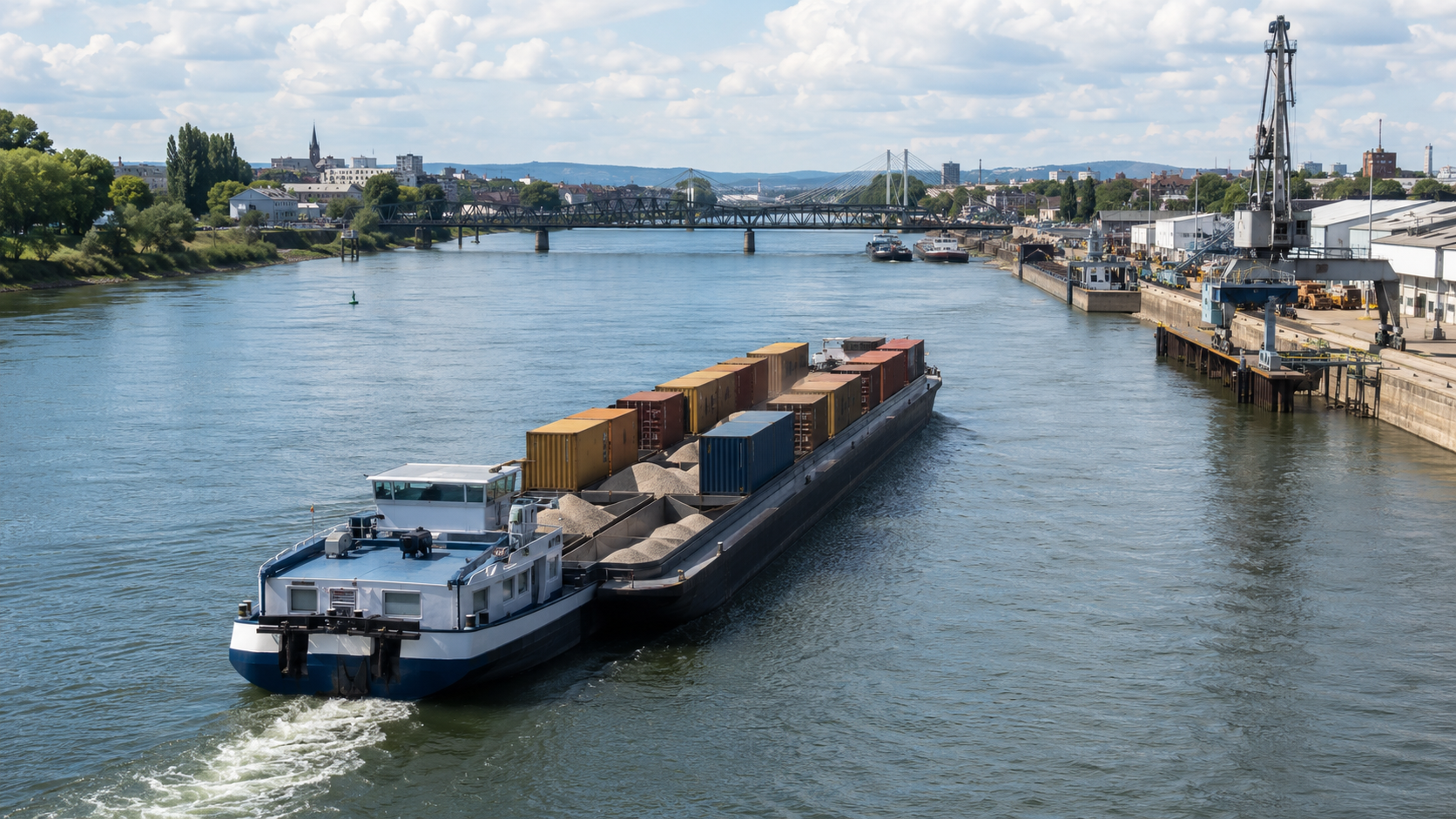
River freight transport is not only a barge sailing from one port to another. In practice, it includes vessels, terminals, handling equipment, storage, documentation and final distribution by road or rail.
Typical elements include:
- barges and pushed convoys for bulk cargo, containers and industrial goods
- self-propelled vessels, which represented almost half of EU inland waterway transport performance in 2024
- river container services between seaports and inland terminals
- river-sea vessels that can connect inland waterways with coastal routes
- port terminals, cranes, silos, warehouses and cross-docking areas
- final road or rail transport from the inland terminal to the consignee
This means river freight is usually part of a combined transport scheme, not a simple door-to-door service. A container can arrive by ocean vessel in Rotterdam, continue by barge to an inland terminal in Germany and then move the final kilometres by truck.
Why Europe is suitable for inland waterway logistics
Europe has a strong natural and industrial base for river transport. The EU inland waterway network covers about 41,000 kilometres across 25 Member States. Many of Europe’s industrial regions developed around rivers such as the Rhine, Danube, Main, Moselle, Scheldt, Meuse, Seine and Rhone.
This matters because river freight works best where industry, terminals and water access are close to each other. Steel plants, chemical sites, grain exporters, construction material suppliers, energy projects and recycling facilities often move large volumes. For these sectors, the cost and capacity logic of water transport can be stronger than relying only on trucks.
In 2024, Eurostat recorded metal ores as the largest goods category moved on EU inland waterways. Metal ores, refined petroleum products, chemicals and agricultural products together accounted for about two-thirds of inland waterway freight performance. This shows where the mode is most competitive: dense, regular and high-volume cargo.
Main river freight routes in Europe
The strongest river freight flows are concentrated along a few major corridors.
- Rhine corridor: Rotterdam, Antwerp and Amsterdam connect with Duisburg, Cologne, Mannheim, Ludwigshafen, Karlsruhe, Strasbourg and Basel. This is one of Europe’s most important inland freight axes, especially for containers, chemicals, metals, mineral raw materials and industrial cargo. Freight transport on the Rhine between Basel and the North Sea reached 284.5 million tonnes in 2024.
- Danube corridor: Germany, Austria, Slovakia, Hungary, Serbia, Bulgaria, Romania, Moldova and Ukraine are connected to the Black Sea region. The route is important for grain, metals, fertilisers, construction materials, project cargo and links between Central Europe, the Balkans and the Black Sea.
- Rhine-Main-Danube connection: the Rhine-Main-Danube Canal links the North Sea and Black Sea systems through the Main and Danube. It is a major infrastructure connection, but it should not be treated automatically as the best route. The decision depends on cargo type, water levels, terminal access, handling cost and transit time.
- Benelux and North-West Europe canal network: the Netherlands, Belgium, northern France and western Germany have dense inland waterway and canal networks, strong container links and many inland terminals serving industrial zones.
Cargo that works best by river
River freight is especially suitable when the shipment is heavy, voluminous, regular and not extremely time-critical. It is also effective when there is a clear loading point, a clear river terminal near the destination and a workable last-mile transport plan.
Suitable cargo includes:
- grain, feed, oilseeds and agricultural products
- ore, coal, scrap, steel, cement, aggregates and construction materials
- chemicals, fertilisers and liquid bulk cargo
- machinery, transformers, turbines and industrial equipment
- oversized and heavy project cargo
- containers, cars and recyclable materials
The cargo does not need to be simple, but it must be planned properly. With machinery and oversized equipment, the main issue is not only the river leg. Access to the port, crane capacity, lashing, lifting points and the road section from the terminal to the final site are often decisive.
Business advantages of river freight
The first advantage is capacity. A single inland vessel can move a volume that would require many truck movements. On suitable routes, barges can carry about 500 to 15,000 tonnes of dry or wet bulk cargo, or roughly 50 to 500 containers per vessel depending on vessel size and route conditions.
The second advantage is cost. River freight can be economically attractive for large volumes and longer distances, especially when the cargo origin and destination are close to terminals. The savings are strongest when the first and last road legs are short and the cargo does not need urgent delivery.
The third advantage is environmental performance. Waterborne and rail transport are among the most greenhouse-gas-efficient motorised freight modes in Europe. For companies with ESG reporting, tender requirements or internal CO2 reduction targets, shifting part of the flow from road to inland waterways can be useful.
The fourth advantage is fewer road constraints. For heavy and oversized cargo, the river can avoid part of the complexity linked to road permits, bridge limits, tunnel restrictions, weekend bans, police escorts and urban traffic.
Where river freight creates real opportunities
River freight is strongest when it solves a concrete logistics problem, not when it is chosen only because it sounds sustainable.
One good scenario is container imports through Rotterdam, Antwerp or Constanta. Instead of moving every box directly by truck from the seaport, containers can be transferred by barge to inland terminals and distributed from there.
Another strong scenario is regular supply to industrial plants. Metallurgy, construction, chemical production, agriculture and energy projects often need steady flows of raw materials or semi-finished products. If volumes are predictable, river transport can become part of a stable supply chain.
A third scenario is project cargo. Transformers, turbines, generators, large machinery and steel structures may be too heavy or complicated for direct long-distance road transport. The river can reduce the number of difficult road kilometres and simplify the overall route.
Practical example: Rotterdam to Duisburg and Central Europe
A container or industrial shipment arriving in Rotterdam can move inland by barge to Duisburg. From there, it can be distributed by rail or truck to destinations in Germany, Czechia, Austria, Switzerland or nearby industrial regions.
This example shows why inland ports are more than unloading points. A good inland port combines river, rail and road transport with storage, customs services, handling equipment and distribution planning. Rotterdam handled 141.9 million tonnes of inland waterway cargo in 2024, while Duisburg remains one of Europe’s most important inland port hubs because it connects river, rail and road networks in the Rhine-Ruhr industrial region.
Practical example: the Danube and South-East Europe
The Danube offers a different type of opportunity. It connects Central Europe, the Balkans and the Black Sea region, with cargo flows such as grain, metals, fertilisers, machinery and construction materials.
For Bulgaria, the Danube is important through ports and access points such as Ruse, Lom, Vidin, Svishtov and Silistra. Published market data show that Ruse, Silistra and Lom are the three largest Bulgarian inland ports. Bulgarian inland waterway transport is strongly shaped by transit flows, especially agricultural products moving downstream and iron ore moving upstream.
In 2023, inland waterway transport in Bulgaria amounted to 13.4 million tonnes. Agricultural products had an average share of 40.0 percent between 2014 and 2023, while iron ores had 13.1 percent. This explains why the Bulgarian section of the Danube is not only a national transport route, but also part of wider Central European and Black Sea logistics.
River freight inside an intermodal plan
River freight works best when it is planned as part of a full intermodal chain. The question is not simply whether a barge is available. The better question is whether the complete route works from loading point to final destination.
A practical plan should combine:
- road freight for first and last mile movements
- rail freight where inland rail links are strong
- warehousing near the port or inland terminal
- customs clearance for international and non-EU cargo
- cross-docking when cargo must be split, consolidated or redirected
- project cargo handling for heavy and oversized equipment
A good forwarding plan must cover the cargo, the terminal, the documents, the loading window, the waterway conditions and the last road stage. Without this coordination, river freight can lose much of its advantage.
Key risks and limitations
River freight is not a universal replacement for trucks. It has real limitations that must be assessed before booking.
The main risks are low water levels, seasonal fluctuations, draught restrictions, lock delays, terminal congestion, limited crane availability and longer transit times. Climate conditions are becoming more important. Recent low-water periods on the Rhine and Danube have forced vessels to reduce loading, split cargo between more barges and accept higher costs.
River freight is usually not the right choice for urgent small shipments, cargo with very short delivery windows, destinations far from any inland terminal or goods that cannot tolerate extra handling. In these cases, road transport or rail may remain more practical.
What companies should check before choosing river freight
Before selecting river freight, companies should verify the complete operational picture, not only the price per tonne.
The key checks are:
- cargo type, weight, volume, packaging and handling sensitivity
- acceptable delivery time and flexibility in the schedule
- nearest river terminal at origin and destination
- crane capacity, lifting equipment and storage options
- water levels and seasonal restrictions on the route
- customs, insurance and dangerous goods requirements
- cost and feasibility of the final road or rail leg
- availability of alternative routes if water conditions change
For oversized cargo, the checklist must go deeper. The shipper should check access roads to the port, quay strength, crane lifting radius, cargo securing, permits for the final road section and the exact route from the inland terminal to the delivery site.
Current trends in European river freight
The European Union is actively encouraging a larger role for inland waterways. The NAIADES III action plan aims to shift more cargo to Europe’s rivers and canals and support zero-emission barges by 2050. The broader EU target is to increase inland waterway and short-sea shipping transport by 25 percent by 2030 and by 50 percent by 2050.
At the same time, the market is changing. Coal volumes are under pressure because of decarbonisation. Chemicals, containers, secondary raw materials, recycling flows and construction materials are becoming more important in several corridors. In 2024, EU inland waterway container transport performance rebounded by 3.7 percent compared with 2023.
Climate risk is now a central planning issue. Low water on the Rhine, Danube and other rivers can reduce vessel loading and increase freight rates. This does not make river freight unreliable by default, but it does mean that shippers need better planning, alternative routing and flexible multimodal options.
Conclusion: a strategic option, not a universal replacement
River freight transport is not the best solution for every shipment. It is slower than road transport in many cases and it depends on terminals, water levels and proper coordination. But for the right cargo, it can be one of the most efficient tools in European logistics.
Its real strength is visible in heavy, bulky, regular and industrial flows where capacity, cost, environmental performance and reduced road complexity matter. The future of European freight will not be only road, only rail or only river. It will be multimodal. Companies that know how to combine these transport modes will have better control over cost, timing, resilience and sustainability.