
Many international shipments in Europe do not move directly from point A to point B. A container, palletised shipment, trailer, machine or project cargo unit may pass through a seaport, inland terminal, rail hub, warehouse or cross-dock centre before reaching the final consignee. At that intermediate point, the cargo is transferred to another truck, train, vessel or barge.
This is the practical role of transshipment. It is not an exception or a sign that something went wrong. In many European supply chains, it is the normal mechanism that makes multimodal logistics possible.
A simple example is a container arriving at Rotterdam. Instead of being trucked all the way to its final destination, it can move by barge or rail to Duisburg and then continue by road to a warehouse in Germany, Czechia, Austria or Bulgaria. This structure allows each part of the route to use the most suitable mode of transport.
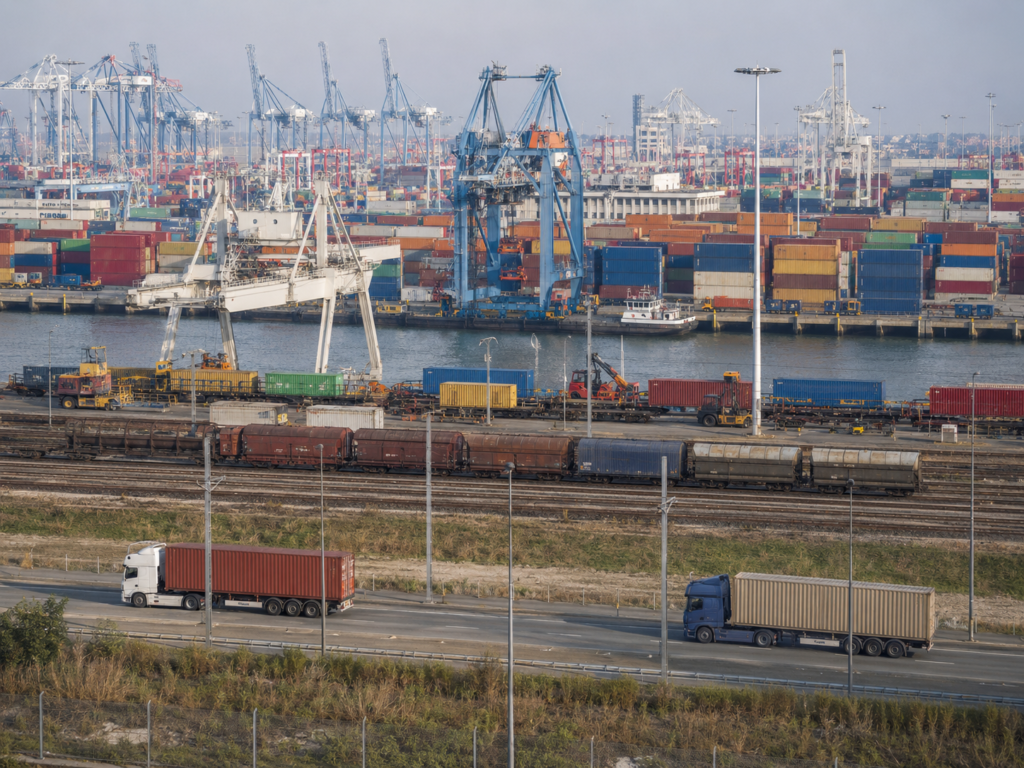
What transshipment means in logistics
Transshipment is the transfer of goods from one transport vehicle, transport mode or logistics hub to another during a shipment’s journey. Eurostat defines the term in maritime transport as unloading goods from one ship and loading them onto another to complete the journey, while also noting that the term can apply more generally to road, rail, air or combinations of transport modes.
In day-to-day logistics, transshipment is broader than simply lifting a container from one vehicle to another. It may include checking cargo units, confirming seal numbers, sorting shipments, temporary storage, changing the carrier, regrouping cargo, customs or document control, and releasing the shipment for the next leg of the route.
The key idea is continuity. The cargo is not considered delivered at the hub. It is passing through the hub so that the route can continue more efficiently.
Transshipment, transloading, cross-docking and consolidation
These terms are often used as if they mean the same thing, but operationally they are different. The distinction matters because each process has different costs, risks, handling requirements and documentation.
- Transshipment means cargo moves through an intermediate hub and is transferred to another vehicle, mode or route. The load unit often remains unchanged, for example a sealed container moved from vessel to rail.
- Transloading means the cargo is taken out of one load unit and placed into another, for example goods moved from a maritime container into a European road trailer.
- Cross-docking means goods move quickly from inbound transport to outbound transport with little or no storage time.
- Consolidation means several smaller shipments are combined into one larger shipment, while deconsolidation means one larger shipment is split into smaller consignments for different destinations.
For business clients, this is not just terminology. A sealed container transshipment has a different risk profile from transloading, where the cargo itself is handled. Cross-docking is different again, because speed and synchronisation are the main objectives.
Why transshipment is so important in Europe
Europe’s freight system is built around strong connections between seaports, inland terminals, rail corridors, road networks and inland waterways. Transshipment is the point where these networks meet.
The European Union’s TEN-T policy also shows why this matters. The European Commission states that the number and capacity of freight transshipment terminals will be expanded to meet traffic demand, including the ability to accommodate 740-metre freight trains. This supports the shift toward more sustainable modes and strengthens combined transport in Europe.
For companies, transshipment makes it possible to divide a route logically: ocean freight for long intercontinental legs, rail for long inland distances, road for final delivery, and inland waterways for heavy or high-volume cargo. Without transshipment points, this combination would be far harder to organise at scale.
Where transshipment happens in Europe
Transshipment can take place in many types of hubs. The most visible are large seaports, but inland terminals and regional warehouse centres are often just as important for the final delivery chain.
Typical European transshipment locations include:
- Seaports such as Rotterdam, Antwerp-Bruges, Hamburg, Koper, Trieste, Constanta, Gdansk and Piraeus.
- Inland intermodal hubs such as Duisburg, Venlo, Bettembourg, Vienna, Budapest, Verona, Lodz and Prague.
- Regional warehouse and cross-dock areas around Sofia, Plovdiv, Bucharest, Belgrade, Zagreb, Milan, Munich and Nuremberg.
Rotterdam shows the scale of this system. In 2025, the port handled 428.4 million tonnes of cargo. Container throughput reached 14.2 million TEU, with TEU volume growing by 3.1 percent compared with the previous year.
Duisburg is another practical example. The Port of Duisburg describes itself as the world’s largest inland port, located on the Rhine, the Ruhr and the Rhine-Herne Canal, with connections by road, rail and water. Its terminal network is trimodal, meaning that cargo can be moved between truck, rail and inland waterway transport within the same hub system.
How the transshipment process works
A well-managed transshipment is not just a mechanical handling operation. It is a coordinated sequence between arrival, verification, handling, documentation and departure.
A typical process includes:
- The cargo arrives at the hub by ship, train, truck or barge.
- The load unit is checked, such as a container, trailer, pallet, crate, machinery unit or oversized cargo.
- Identification is confirmed through documents and references such as container number, seal number, barcode, CMR, MRN, Bill of Lading or terminal reference.
- The cargo is unloaded or moved using cranes, reach stackers, forklifts, ramps or specialised handling equipment.
- Temporary storage is used if the next vehicle, train, vessel or barge is not yet ready.
- The cargo is transferred to the next transport mode.
- Documents and operational statuses are updated.
- The shipment continues with a status such as arrived, transshipped, released, loaded or departed.
Good transshipment is not measured only by how fast a crane can move a container. It depends on the synchronisation of arrival times, terminal slots, customs status, equipment availability, documentation and communication between all parties.
Which types of cargo often use transshipment
Transshipment is common across many sectors because it allows cargo to move through the most efficient hub-and-spoke route rather than relying on a single direct transport option.
Common cargo categories include:
- Containers with consumer goods moving from Asia to European markets.
- Automotive parts for factories in Germany, Czechia, Slovakia, Hungary and Romania.
- Machinery, production equipment and industrial components.
- Textiles, furniture, electronics and spare parts.
- Food products and temperature-controlled cargo.
- Chemicals and dangerous goods under controlled conditions.
- Oversized and project cargo.
- Groupage shipments sorted toward different European countries.
Not every cargo is suitable for frequent handling. Fragile, high-value, temperature-sensitive or technically complex cargo requires stricter control, fewer intermediate operations, better packaging, clear liability and reliable status reporting.
Cargo transfer between European hubs: typical routes
In Europe, transshipment is often used to connect large maritime gateways with inland consumption and production zones. The following route patterns are especially relevant in practical freight planning:
Rotterdam or Antwerp-Bruges to Duisburg, then onward to Germany, Czechia, Austria or Poland. This corridor is suitable for containers, industrial goods, retail flows and e-commerce cargo, especially where inland rail or barge can reduce pressure on long-distance road transport.
Hamburg or Bremerhaven to Prague, Lodz or Budapest. This is a common north-to-central Europe logic, where seaport capacity is linked with inland hubs serving manufacturing, distribution and regional warehousing.
Trieste or Koper to Austria, Hungary, Slovakia and southern Germany. Adriatic ports are important for cargo moving toward Central and South-Eastern Europe because they can shorten the maritime approach from the Mediterranean and connect with inland rail and road corridors.
Constanta to Romania, Bulgaria, Serbia, Moldova and Ukraine. This route is practical for Black Sea and Balkan supply chains, especially where cargo must connect maritime, Danube, road and rail options.
Istanbul and Turkey to Sofia, Plovdiv, Bucharest or Belgrade, then onward to Central Europe. This pattern is relevant for textiles, automotive parts, machinery, fast-moving consumer goods and groupage shipments.
The point is not that every shipment must use these hubs. The point is that European cargo flows often become more efficient when a hub is used to change mode, combine shipments or redistribute cargo toward several countries.
Business advantages of transshipment
For companies, transshipment is useful when it improves the overall route, not when it simply adds another handling point.
The main advantages are practical:
- Lower cost per tonne, pallet or container when long legs can move by rail, inland waterway or consolidated road transport.
- Better capacity use because containers, trains, barges and groupage vehicles can be filled more efficiently.
- More routing flexibility during congestion, strikes, driver shortages, port disruption or capacity restrictions.
- Wider country coverage from one inland hub or regional warehouse.
- Easier consolidation of shipments from several suppliers.
- Better access to lower-emission transport options, especially rail and inland waterway transport.
This is not theoretical. European combined transport continued to grow in 2025. UIRR reported almost 3.9 million intermodal consignments and 81.03 million gross tonnes transported, with gross tonnes rising by 3.72 percent from the previous year.
Risks and common problems in transshipment
Transshipment is not a problem in itself. It becomes a problem when it is poorly planned, poorly documented or poorly coordinated.
The most common risks include:
- Late arrival of the first transport leg.
- Missed train, barge, vessel or truck slot.
- No available terminal capacity at the expected time.
- Document errors or mismatches between cargo, declarations and transport references.
- Damage during handling.
- Lost, damaged or incorrectly recorded seals.
- Extra charges for storage, waiting time, demurrage or detention.
- Special risks for temperature-controlled, dangerous or fragile goods.
The business impact can be significant. A missed rail slot can delay the whole route. A wrong container number can block release. A damaged seal can trigger inspection. A late customs document can turn a planned cross-dock into paid storage.
How to manage a transshipment process properly
A reliable transshipment process starts before the cargo reaches the hub. The route, documents, timing and responsibilities must be clear in advance.
A practical operating checklist should include:
- Book terminal slots before the cargo arrives.
- Send clear handling instructions to the terminal or warehouse.
- Check transport and customs documents before arrival.
- Confirm container numbers, seal numbers and cargo references.
- Use entry and exit photos for sensitive, valuable or damaged cargo.
- Track ETA and ETD for every transport leg.
- Prepare a backup route or alternative slot for delays.
- Assign one coordinator to follow the whole chain, not only one transport leg.
The role of the freight forwarder is to connect the moving parts: maritime transport, port or terminal, warehouse, customs agent, rail operator, inland waterway operator and road carrier. The client needs one operational picture, not five separate updates from five different parties.
Transshipment and sustainable logistics
Transshipment is one of the practical conditions for more sustainable freight. Cargo can only shift from road to rail or inland waterways if there are hubs where it can be transferred efficiently.
Eurostat reported that EU inland waterway freight transport reached 473 million tonnes in 2024, an increase of 0.9 percent from 2023. Measured by transport work, inland waterways reached 122 billion tonne-kilometres, up by 4.5 percent.
This does not mean that the greener option is always the fastest. Rail and inland waterways depend on schedules, terminal capacity, river conditions and network reliability. But for regular flows, heavy cargo, high-volume shipments and planned distribution lanes, transshipment can make lower-emission routes commercially realistic.
What companies should ask before choosing a route with transshipment
Before accepting a route with one or more transshipment points, a company should ask clear operational questions:
How many times will the cargo be handled? Where exactly will the transfer take place? Who is responsible at each stage? Will the cargo be temporarily stored, and what will that cost? How will the cargo condition be checked? Are there possible demurrage, detention, waiting or storage charges? Which documents are required before release? Is there a backup route if the first plan fails? Is the cargo suitable for transshipment, or would direct transport be safer?
These questions turn transshipment from a vague logistics term into a controlled process. When planned well, it reduces cost, expands routing options and makes multimodal transport possible. When ignored, it becomes a source of delays, disputes and unexpected charges.
For European logistics, transshipment is not just cargo transfer. It is the connection point between ports, rail corridors, inland waterways, warehouses and final road delivery. It is one of the quiet mechanisms that keeps European freight moving.