
A container can be below its maximum gross mass and still be unsafe to transport. A machine resting on two narrow feet may overload part of the floor; a top-heavy load may tip; unsecured pallets may move when the ship rolls or the truck brakes. Safe container loading therefore starts with a documented packing plan, not with the assumption that closing and sealing the doors makes the cargo secure.
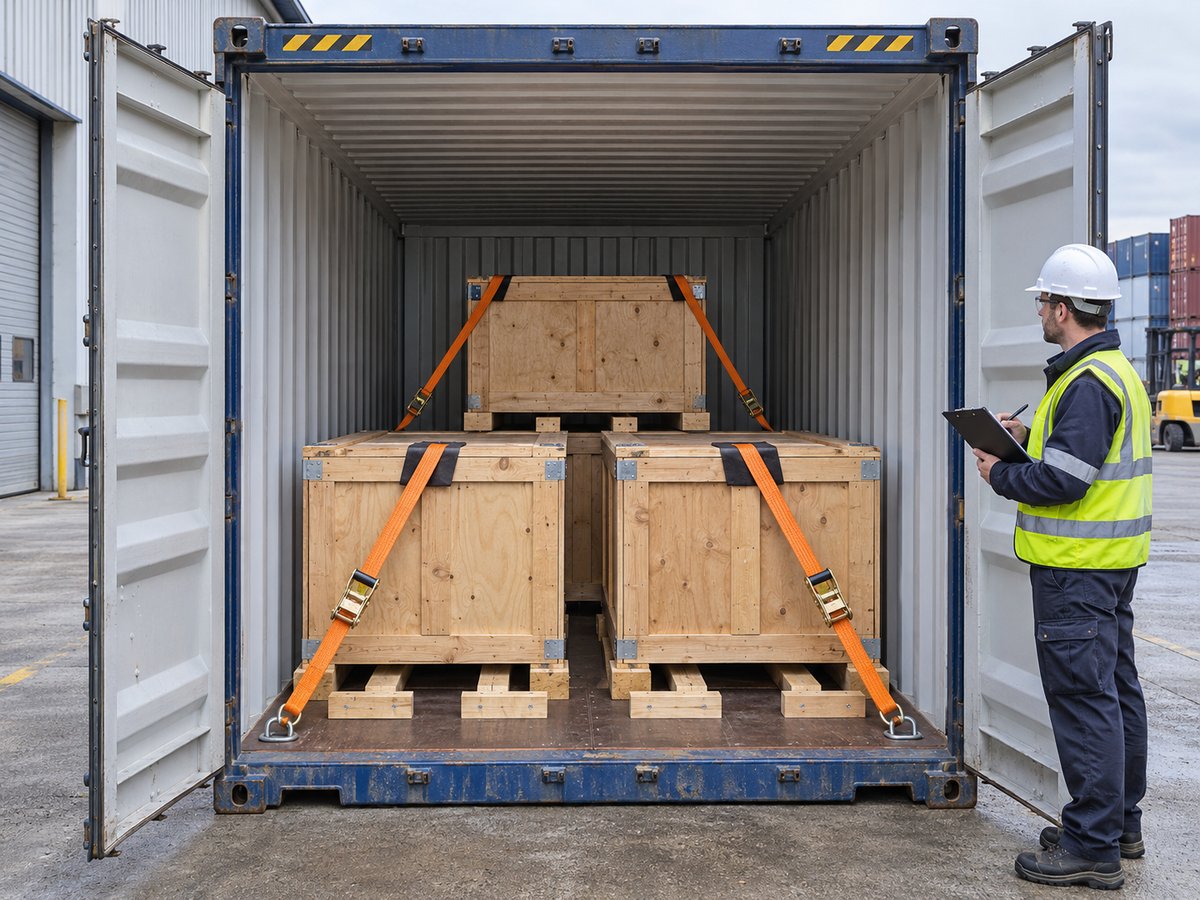
Agree the loading plan and responsibilities first
Give the packing team an itemised cargo description: package dimensions and mass, orientation, stackability and, for machinery, its centre of gravity and support footprint. The plan should show each item’s position, the intended restraint and the loading sequence. Otherwise the final package can block access to a lashing point or make safe unloading impossible.
Identify who provides cargo data, who physically packs and secures the container, and who checks completion. A freight forwarder arranging transport is not automatically the company carrying out the lashing. Record instructions and any technical approvals before work starts. The IMO/ILO/UNECE CTU Code is a non-mandatory international code of practice for cargo transport units, not a universal certificate proving that a particular load is safe.
Inspect the container and confirm that it is suitable
Container selection must account for the loading method as well as the goods. A standard dry container may be unsuitable where a crane must lower a machine from above, where the load exceeds the available opening or where concentrated loading needs a different unit. Before packing, check:
- Structure and floor: look for distortion, damaged flooring, protrusions and signs of repair that could affect the planned support or restraint.
- Weather protection: inspect the roof, walls, doors and seals for holes, water trails and damage; reject a leaking unit rather than relying on extra wrapping.
- Cleanliness and dryness: check for moisture, residues, odours and contamination incompatible with the cargo.
- Securing points: establish their position, condition and rated capacity for the proposed arrangement; a convenient wall feature is not necessarily an anchor.
- Technical and access limits: verify the unit’s identification, permissible masses and examination status, plus the loading ramp and the floor loads imposed by a loaded forklift.
Photograph and report a defect before loading obscures it. The HSE’s freight container safety guidance explains the importance of fitness for use and adequate packing support; an apparently intact exterior does not establish suitability for a heavy point load.
Separate packing costs from the freight rate
A transport quotation should distinguish container movement from preparation of the cargo. Packing costs can include labour, timber supports or crates, rated securing equipment, lifting machinery, technical design, weighing and an independent survey where required. An unusual machine may need a support design before a reliable packing price can be offered.
Ask which materials and operations are included, who performs them and what completion record will be supplied. A single unspecified charge for “container lashing” does not show whether the actual load has been assessed, and paying for an inspection does not eliminate all transport risk.
Weight distribution and concentrated floor loads
Maximum gross mass covers the loaded container as a whole; payload concerns the cargo and packing carried inside it. Neither figure alone establishes how a particular machine can stand on the floor. Longitudinal and lateral distribution, the centre of gravity and concentrated forces at individual supports must also be considered.
Consider an illustrative 8-tonne machine resting on two narrow feet. There may be ample unused payload capacity, yet the small contact area can still make the proposed floor loading unacceptable. A competent assessment must establish an appropriate load-spreading support and how it transfers force into the container structure. The machine’s total mass alone cannot determine a safe timber thickness or a universal support layout.
Keep heavy cargo low and plan its position across the available floor, taking account of the whole transport chain; “put everything heavy at the front” is not a safe general rule. Road chassis axle loads are a separate constraint. A correctly declared container mass does not certify that the chosen truck and chassis will meet their axle limits.
Blocking, bracing and lashing serve different purposes
The securing arrangement must resist sliding and tipping under the conditions expected on the road, rail and sea legs. Its design depends on cargo geometry, friction, anchor capacities and the strength of both packaging and supports. Common measures include:
- Compact stowage: compatible, sufficiently strong packages can support an organised load pattern, but weak cartons cannot safely restrain a heavy neighbouring machine.
- Blocking and bracing: properly designed supports restrain movement and distribute forces; their connection and bearing area matter as much as their size.
- Rated lashings: suitable equipment, attachment points and angles address the identified forces. There is no strap count that is correct for every container.
- Anti-slip material: appropriate material can improve friction, but does not independently solve tipping or replace the rest of the securing design.
- Dunnage airbags: correctly selected bags can fill permitted gaps between suitable surfaces; they are not a universal restraint for machinery or an excuse to overload walls and doors.
Stretch film can unitise cartons on a pallet without anchoring that pallet to the container. Likewise, the doors and corrugated walls have finite strength: they must not be treated as unlimited blocking surfaces. Consult the CTU Code’s packing and securing guidance alongside the actual equipment specifications, rather than copying a lashing layout from a different load.
Different plans for pallets, machinery and rolls
For palletised cartons, establish compression strength and permitted stacking before adding a second tier. Pallet condition, overhanging boxes and empty spaces affect the load’s stability. A tightly wrapped pallet can still collapse if cartons beneath it cannot carry the imposed weight.
A tall machine needs verified support points and a restraint arrangement addressing its high centre of gravity. Packaging that protects painted surfaces may not be strong enough to transmit lashing forces. Confirm where the manufacturer permits lifting and securing, and have unusual or heavy loads assessed by a competent specialist.
Rolls and other cylindrical cargo introduce a rolling risk. Orientation, supporting cradles or chocks, contact protection and restraint must be selected for the actual product and transport conditions. A loose wedge or a neighbouring package is not evidence of an adequate arrangement. Dangerous goods require their own applicable assessment and documentation; this overview is not an IMDG packing manual.
Prevent moisture, abrasion and packaging damage
- Dry cargo and materials: avoid introducing wet goods, pallets or dunnage into a closed container, and protect the load during packing.
- Compatibility and segregation: separate goods that could contaminate, stain or damage one another, including through odours or leaking contents.
- Edges and contact surfaces: protect straps and cargo from sharp edges, and prevent repeated rubbing against adjacent items during movement.
- Condensation control: choose product- and route-appropriate barriers, packaging and moisture-control measures rather than applying one desiccant quantity to every load.
- The door end: provide suitable restraint against cargo falling out when the doors are opened, without preventing a planned safe unloading sequence.
Desiccants cannot repair a leaking roof or make wet cargo dry enough for shipment. Exposure during outdoor packing and intermediate handling must also be considered, as discussed in TT Club’s wet-damage prevention guidance. For solid-wood packaging and dunnage, check the destination’s phytosanitary requirements and the applicability of ISPM 15; do not assume identical treatment and marking requirements for every European movement.
Weighing and submitting the verified gross mass
For packed containers covered by the SOLAS requirement, verified gross mass (VGM) includes the cargo, packaging, pallets and securing materials, together with the tare mass of the actual container. Using the cargo invoice weight alone leaves part of that mass out.
The IMO’s VGM guidance sets out two methods: weigh the packed container, or weigh the contents and packing materials and add the container tare using a certified method approved by the competent authority where packing was completed. Establish who is named as shipper in the transport documentation and who submits the signed information to the carrier and terminal in time for ship stowage planning.
The terminal’s VGM deadline and cargo reception deadline may differ. VGM is a mass declaration, not confirmation of safe lashing, correct weight distribution or an entitlement to vessel loading.
Final checks, photographs and safe opening
Nominate the person who checks and signs off completion. If the actual package, support or securing differs from the approved plan, resolve that discrepancy before dispatch rather than describing an unfinished operation as complete.
- Plan compliance: confirm package count, orientation and positions, and record any approved changes.
- Support and restraint: check the installed supports, anchors, lashings and remaining gaps against the agreed arrangement.
- Photographic record: retain identifiable views before packing, during installation and at completion, including details that will disappear behind the final packages.
- Identification and documents: record container and seal numbers, mass information, cargo description and the documents handed to the next participant.
- Unpacking instructions: explain access, lifting and restraint-release requirements, including the risk of load pressure behind the doors.
A seal indicates neither safe contents nor an undamaged securing arrangement. The receiving team must assess possible shifting before opening and releasing restraints. The Cargo Integrity Group’s container packing checklist is a useful operational reference; completed checklists and photographs still do not guarantee an insurance payment if damage occurs.
Coordinating container preparation through IFA members
The IFA network of independent freight forwarders provides a starting point for coordinating the transport chain. Agree the cargo data, packing contractor, necessary technical assessment, terminal deadlines and handover records with the member arranging the shipment. Specialist equipment, engineering services and warehouse capabilities must be confirmed for that particular operation, not assumed to be available from every member.