
Ro-Ro freight transport lets vehicles, trailers and suitable industrial loads travel by sea without being lifted individually into a container ship. The cargo rolls aboard on its own wheels or on a handling platform, then continues inland after discharge. Whether this is better than an all-road journey depends on the complete route: terminal access, acceptance of the actual load, sailing frequency and the delivery deadline matter as much as the sea freight rate.
Rolling cargo, unaccompanied trailers and rolltrailers
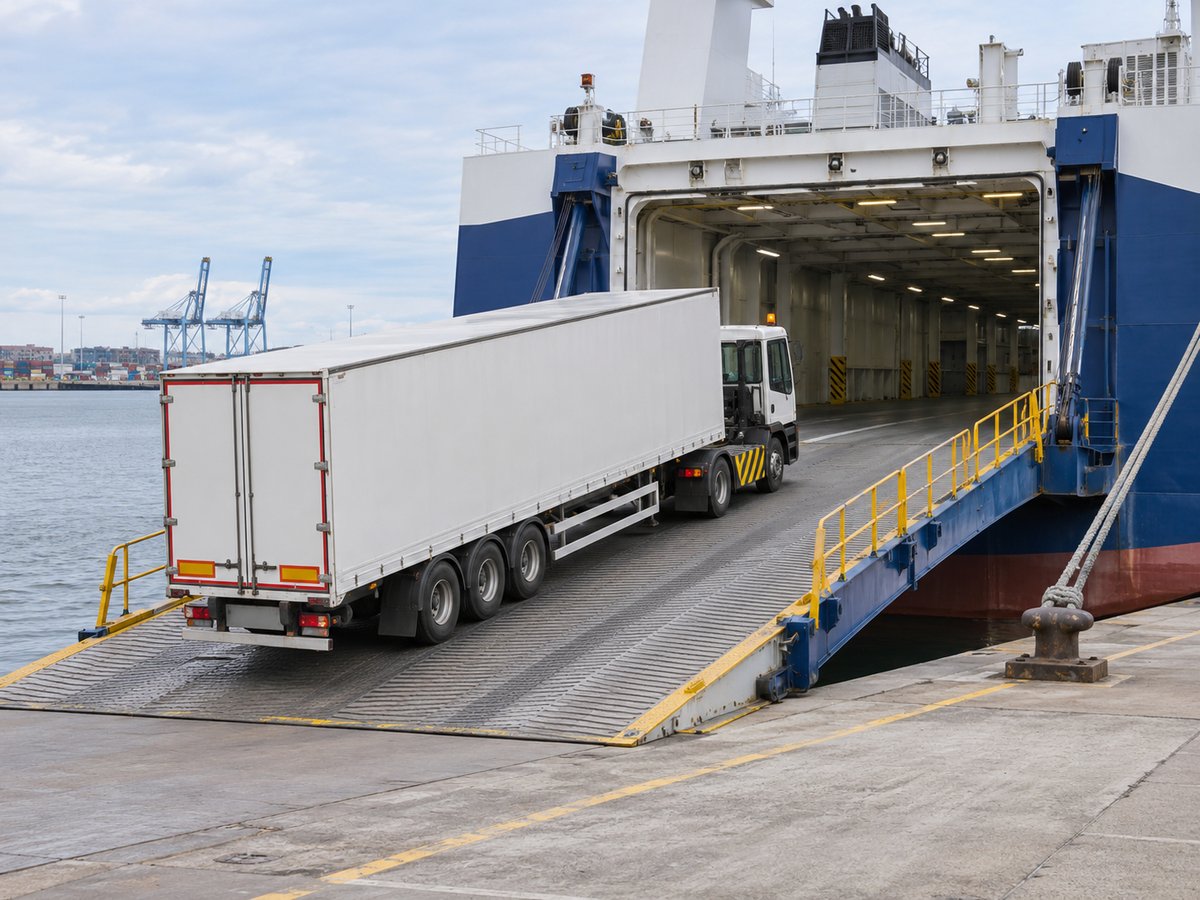
A self-propelled vehicle can be driven aboard if it meets the service’s technical and safety requirements. An unaccompanied semitrailer is delivered by one road tractor, moved aboard by terminal equipment and collected by another tractor at destination. The driver and road tractor therefore need not complete the sea crossing.
A machine without suitable wheels may instead travel on a rolltrailer, often called a MAFI platform. This is handling equipment, not automatically a road-legal trailer: the booking must identify where the machine is lifted onto it, who provides it and how the cargo transfers back to road transport. Vehicle carriers, freight Ro-Ro vessels and passenger ferries have different layouts and acceptance conditions. For accompanied trucks and a geographical overview of crossings, see our guide to freight transport by ferry in Europe.
Cars, construction equipment and industrial cargo
- Passenger cars and commercial vehicles: provide dimensions, mass, propulsion type and running condition. A damaged or non-running vehicle needs specific approval rather than a standard drivable-vehicle booking.
- Buses and trucks: overall height, wheelbase, ground clearance and overhangs determine whether the vehicle can negotiate the ramp and fit the assigned deck.
- Wheeled and tracked machinery: declare attachments, actual transport dimensions and usable securing points. Tracks, low clearance or unusual axle loads may require special handling and deck protection.
- Industrial machines and structures: a rolltrailer may make a non-wheeled load suitable for Ro-Ro, but its combined dimensions, mass, support arrangement and securing design must be accepted first.
The relevant measurement is the complete shipping configuration, including projecting buckets, exhausts, skids and packaging. A nominal machine model or an old brochure is not a substitute for measured transport dimensions.
The complete cost from collection to delivery
Compare quotations for identical collection and delivery addresses and the same cargo configuration. Depending on the service, sea freight may be rated per unit, by dimensions, occupied deck space or lane metres. A low sailing rate can be outweighed by expensive handling or long road legs.
- Road collection and delivery: include the required vehicle, permits where applicable, terminal appointments and empty-equipment positioning.
- Sea passage: identify the booked unit and any applicable fuel or environmental surcharges, including how they are calculated.
- Terminal operations: check handling, measurement, inspection and special acceptance charges rather than assuming all services are included.
- Platforms and securing: distinguish rolltrailer provision, lifting, supports and lashing from the sea freight charge.
- Storage and delays: confirm free time, storage rates and responsibility for late collection or a missed sailing.
European Ro-Ro links and the corridors they serve
The following links illustrate different uses of Ro-Ro rather than interchangeable products. Times are approximate port-to-port planning figures, not delivery promises; the sailing, terminal and cargo acceptance must be reconfirmed when booking. In particular, a route that carries trailers does not necessarily accept a privately shipped car on the same terms.
- Gothenburg–Zeebrugge: Sweden to Belgium, linking Gothenburg RoRo Terminal with the booked Zeebrugge freight terminal. Published direct schedules indicate roughly 32–34 hours. Unaccompanied units are a principal application; self-drive and special cargo require confirmation. The route connects western Sweden with Belgian and neighbouring inland markets.
- Gothenburg–Ghent: Gothenburg RoRo Terminal to the freight terminal in Ghent, Belgium. The October 2026 standard pattern gives approximately 31–33 hours from Gothenburg; some rotations involve Brevik, so the actual call sequence matters. Trailers, self-drives and machinery have separate acceptance arrangements. Ghent provides access to the Benelux industrial hinterland.
- Gothenburg–Immingham: Sweden to England’s Humber region. The published standard pattern indicates roughly 28–30 hours on direct sailings after allowing for the time-zone difference; services calling at Brevik take longer. Booked trailers and approved vehicles or machinery can serve northern England and the Midlands through the Immingham freight terminal.
- Rosslare–Zeebrugge: Ireland to Belgium, using Rosslare Europort and the specified Zeebrugge Ro-Ro terminal. The published 2026 planning pattern is around 32–35 hours, depending on sailing and direction. This direct maritime connection suits accepted freight units, including unaccompanied trailers, and avoids a road transit across Great Britain. Collection slots and terminal release still add time.
- Pendik–Trieste: the Pendik terminal on Istanbul’s Asian side to the Ro-Ro terminal in Trieste, Italy. The route information gives approximately 64 hours, subject to the selected sailing. Trailers and complete vehicles are among the accepted categories; oversized units need approval. Trieste offers onward road and rail options towards northern Italy and Central Europe, while the Turkish leg introduces customs requirements.
Gothenburg RoRo Terminal’s destination information and Rosslare Europort’s freight service information are useful starting points for checking port connections. The precise terminal must also match the booking: naming only the port city is insufficient for delivery instructions.
Terminal acceptance and securing for the sea leg
Obtain acceptance before dispatching unusual cargo to the quay. The terminal needs the unit’s actual dimensions and mass, running condition, handling method and securing information. For machinery, ramp capacity and geometry, deck loading and suitable lashing points can all be limiting factors. Photograph existing damage and record the equipment identifier at handover.
Fuel, batteries, loose belongings and dangerous-goods declarations depend on the vehicle and the particular service. A road securing arrangement is not automatically adequate at sea: movements and the vessel’s securing requirements must be addressed explicitly. Confirm who performs and checks the marine lashing, including any preparation required before the terminal will accept the unit.
Sailing frequency, cut-offs and storage risk
Build the timeline backwards from delivery: inland collection, terminal reception, waiting for departure, sea passage, discharge, release and final road delivery. Missing a reception cut-off can mean waiting for the next suitable sailing, not simply arriving a few hours late. Availability for an unusual load may also differ from general deck availability.
At destination, documents, collection equipment and the receiving address must be ready before the unit becomes available. Otherwise storage accumulates while the sea crossing itself remains on schedule. Fewer road kilometres and less driver time do not necessarily mean a shorter door-to-door transit.
Three comparisons with all-road transport
For a batch of cars between the Iberian Peninsula and northern Europe, a suitable vehicle-carrying service may reduce long-distance road movements. Compare port delivery, vehicle acceptance, loading frequency and final distribution with the capacity and timetable of a road car transporter. A ship’s ability to carry cars does not establish that any individual sailing accepts the batch.
For an unaccompanied trailer between the Benelux region and Sweden, separate tractors can handle the two inland legs while the trailer travels by sea. This can suit a repeatable delivery pattern, provided the trailer can remain unavailable during the crossing and a collection tractor is committed at the receiving port.
For a machine needed at a building site far from a suitable port, an all-road solution may be more practical. Extra platform handling, a missed sailing or a lengthy final road leg can remove the maritime advantage. These are planning comparisons, not examples of guaranteed savings or completed customer projects.
Customs documents, handover and damage cover
For movements within the EU, establish the goods’ customs status and any evidence required for the particular sea service. Routes involving Great Britain or Turkey need the relevant import, export or transit arrangements. Agree who supplies commercial documents, cargo and vehicle identifiers, and customs references before terminal reception.
Cargo insurance and the liability of each transport participant are different matters. The applicable contract and legal regime may differ between a vehicle shipped as cargo and goods remaining inside a road vehicle during a crossing. Check the actual multimodal arrangement, exclusions and claims procedure; do not assume that one liability policy covers every handover or the cargo’s full value.
Coordinating a Ro-Ro shipment through IFA members
IFA brings together independent European freight forwarders. A suitable member can assess the road and sea combination and coordinate with the parties handling terminal delivery and collection. The IFA partners directory identifies the network; availability of a particular route, handling platform or specialist operation must be checked with the member arranging the shipment.
- Addresses and timing: collection and delivery locations, cargo-ready date and the latest acceptable arrival.
- Unit information: description, quantity, measured dimensions, mass and whether each vehicle or machine can move under its own power.
- Handling and securing: photographs, ground clearance, support requirements and usable lashing or lifting points.
- Special conditions: batteries, fuel, dangerous goods, damage, access restrictions and documentation requirements.