
Consolidated air freight combines shipments from different customers moving on a compatible route and schedule. Each shipment keeps its own identity and documents, while the main air movement and part of the terminal handling are organised under a shared consolidation. For several cartons or a few pallets, this can avoid paying for capacity that the shipment does not need.
The trade-off is planning. A consolidation has a warehouse cut-off, a planned build-up and a selected flight. It can be more economical than a direct arrangement, but the total door-to-door time includes collection, waiting for the consolidation, airport handling, customs clearance, breakdown and final delivery.
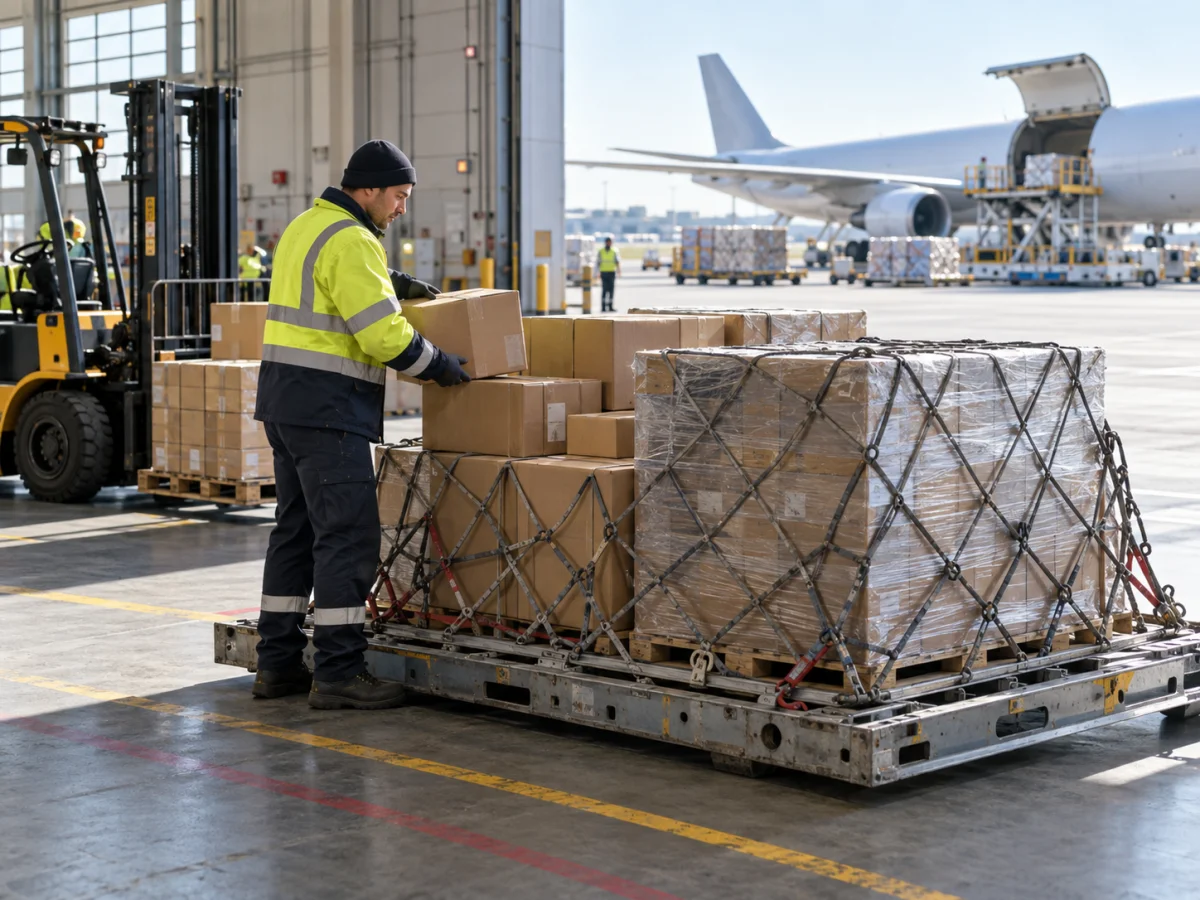
How an air freight consolidation works
The origin forwarder receives the individual shipments at a controlled warehouse, checks piece count, condition, dimensions, weight and documents, and groups compatible cargo for the booked route. An authorised cargo operator builds an aircraft pallet or container where required. The unit then enters the carrier process for security acceptance, flight handling and transport.
At destination, the consolidation is broken down into the individual house shipments. Each one is matched to its documents, customs status and delivery instruction before release. The principal stages are:
- collection and receipt at the origin warehouse;
- measurement, document check, security status and route allocation;
- build-up, airline acceptance and main air transport;
- destination breakdown, customs clearance and terminal release;
- final delivery with shipment-level proof of handover.
A House Air Waybill identifies an individual consignment handled by the forwarder, while the Master Air Waybill represents the carrier-level shipment. IATA’s guidance on advance cargo information explains that house-level data belong to the forwarder and master-level data to the carrier. The relationship must remain accurate throughout the consolidation.
Suitable shipments and important restrictions
Consolidation is commonly useful for several cartons, one or more pallets, spare parts, components, samples and regular replenishment that cannot move as a parcel but does not justify a dedicated solution. It works best when the cargo is ready before a known cut-off and the consignee can accept the published service window.
- standard, well-packed general cargo that can be safely handled with other shipments;
- small or medium consignments with accurate dimensions and a predictable ready date;
- regular flows where planned departures are more valuable than ad hoc booking;
- cargo whose delivery deadline allows origin consolidation and destination breakdown.
Dangerous goods, lithium batteries, pharmaceuticals, perishables, valuable cargo, live animals and temperature-sensitive products require separate acceptance checks. Oversized pieces, non-stackable freight and items with unusual handling points may use disproportionate ULD space. They may still be accepted, but not under the same plan or rate as ordinary stackable cargo.
Pricing and chargeable weight
Air freight is priced using chargeable weight. The actual gross weight is compared with the volumetric weight, and the higher value is generally used. IATA’s explanation of air cargo tariffs gives the common metric example of volume in cubic centimetres divided by 6,000, but the applicable factor, minimum and tariff must be checked for the specific service.
A quotation should show the scope around the air rate, because airport-to-airport freight is only one component:
- collection, origin warehouse handling and export documentation;
- measurement, security screening and special-cargo checks;
- main air freight, fuel, security and other applicable surcharges;
- destination terminal handling, storage and customs services;
- final delivery, insurance and any exceptional handling.
Exact dimensions matter. A light pallet with large volume may be charged above its scale weight, while an undeclared overhang or “do not stack” instruction can change both the chargeable weight and the capacity available on the consolidation.
Where the saving comes from for smaller shipments
Several house shipments share the line-haul booking and parts of the build-up and terminal process. This can produce a better cost per shipment than arranging a direct movement for each small lot. The saving is operational, not automatic: it depends on destination, frequency, available capacity, density and the time the shipper can allow.
A dense pallet may price efficiently by actual weight. A large lightweight crate may consume scarce aircraft volume and provide little consolidation advantage. Peak periods, restricted capacity and an urgent last-minute booking can also remove the expected saving. The correct comparison uses total door-to-door cost and the same delivery deadline, not only the airport air rate.
Schedule, cut-off and realistic transit time
Flight time is only one part of the service. The origin cut-off may be many hours before departure because the cargo must be received, screened, documented, built into a load and tendered to the carrier. A missed cut-off can move a house shipment to the next planned consolidation even if the booked aircraft has not departed.
The realistic schedule includes collection, origin acceptance, planned waiting, departure, any flight connection, destination handling, breakdown, customs release and delivery. Weekends, terminal working hours and customs queries must be considered. The IATA Cargo Handling Manual overview identifies latest acceptance time, shipment preparation, build-up, flight dispatch, breakdown and delivery as distinct operational steps.
Consolidated or direct air freight
A direct service is preferable when the last acceptable delivery date leaves no room for a consolidation cycle, when the cargo is highly sensitive to repeated handling, or when its size already fills the relevant capacity. Consolidation is attractive when the shipment is smaller, properly packed and compatible with a planned departure.
- compare the delivery deadline, not only the scheduled flight;
- calculate the business cost of one missed departure or production stop;
- consider chargeable weight, stackability and the number of handling points;
- check departure frequency and the recovery plan for offloaded cargo;
- state whether speed, cost, handling control or schedule certainty has priority.
A charter or other dedicated solution is a different cost category and is normally justified by exceptional size, urgency or operational control. For ordinary small and medium shipments, the relevant comparison is often between a planned consolidation and a direct scheduled-air booking.
Packaging, dimensions and preparation for shared handling
Consolidated cargo passes through reception, screening, build-up and breakdown. Packaging must protect the goods through forklift, conveyor or manual handling appropriate to the piece. Cartons need sufficient compression strength, pallets must be sound, and edge protection should prevent straps or wrapping from cutting into the load.
Every piece requires a readable shipment mark that matches the documents. Provide exact length, width, height and gross weight after final packing. Declare overhang, protrusions, lifting points, centre-of-gravity issues and any prohibition on stacking. The IATA describes a ULD as an aircraft container or a pallet-and-net combination, and its ULD guidance emphasises safe build-up, restraint, transfer and storage.
Documents, security screening and customs clearance
The basic commercial file normally contains a commercial invoice and packing list, plus accurate shipper, consignee, goods description, value, origin and tariff data where applicable. Air waybill instructions must match the physical pieces. Licences, certificates or dangerous-goods declarations are added according to the commodity and route.
Aviation-security status and screening method must be recorded for each shipment. Cargo that cannot be screened by the planned method because of density, dimensions or product sensitivity may require an alternative procedure and additional time. Export, transit and import formalities depend on the actual countries and customs status; movement within Europe is not automatically an intra-EU customs movement.
More handling points and risk control
Consolidation adds planned handling at the origin warehouse and destination breakdown. The principal risks are damaged packaging, missing pieces, incorrect labels, a late document, loss of shipment identity or a missed cut-off. Controls should follow each house shipment rather than only the master consolidation.
- record piece count, weight, dimensions and visible condition at receipt;
- photograph exceptions and scan each handover against the house reference;
- verify labels before build-up and again during destination breakdown;
- retain clear custody records and define escalation for short or damaged cargo;
- arrange cargo insurance appropriate to the goods and declared risk.
A recovery plan should state who acts if cargo misses the booked flight, is held for security inspection or arrives without a matching document. Early escalation is more useful than a generic status update after the delivery deadline has passed.
Consolidated air freight through IFA
For a workable proposal, provide collection and delivery addresses, cargo-ready date, final delivery deadline, number and type of pieces, exact dimensions and gross weight, commodity and value, stackability, dangerous-goods or temperature status, customs requirements and any special handling instruction.
Appropriate members of the IFA network can coordinate origin receipt, consolidation, air transport, documents, destination breakdown and delivery in Europe. The planned routing, departure frequency and acceptance conditions should be confirmed for each shipment. To identify suitable network coverage for a lane, contact the International Forwarding Association.